
Author: Amam Okafor
The distribution and administration of Covid-19 vaccines are creating unpalatable challenges. On one hand, high-income countries (HICs) are circumventing COVAX, a coalition established to coordinate the equitable distribution of COVID-19 vaccines globally, to enter direct purchase agreements with big pharmaceuticals. The result is the inequitable access to vaccines to low-income countries (LICs) and the continued spread of the mutating virus. On the other hand, anti-vaccination propaganda has caused tremendous vaccine hesitancy and wastage across the world even more so in the HICs where they have stockpiled more vaccines than necessary.
The WHO vaccination data shows that over 17.2 billion vaccine doses have been procured globally. According to data from Our World in Data, about 9.4 billion doses have been administered – representing 54.7% of procured vaccines. As of January 8, 2022, total administered doses represent 59.1% of the global population, of which 49.93% are fully vaccinated and 9.15% are partially vaccinated. HICs and upper-middle-income countries (UMICs) have achieved comparatively high vaccination rates (see figure 1). Figure 1 shows that HICS and UMICs have administered at least 20 times more vaccines than in LICs. Countries such as China, UAE, the US, and Germany have higher vaccination rates than LICs and Africa.
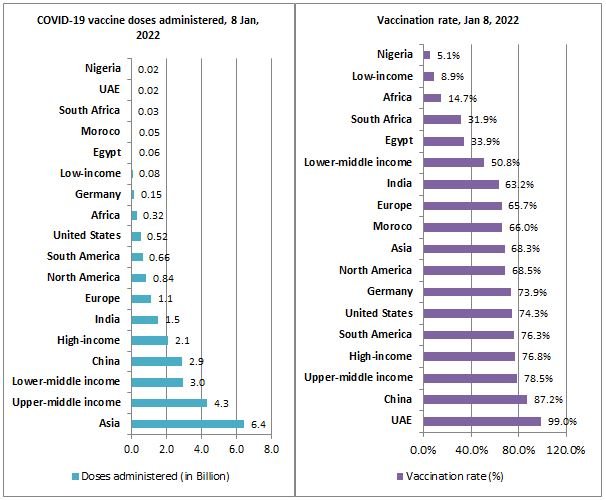
In Africa, the vaccination rate is low compared to other regions – 14.7% (see figure 1). Vaccination in Africa accounts for only 3.3% of vaccines administered globally. The Africa Centre for Disease Control data shows that 58.7% of total vaccines supplied were administered as of 5 January 2022. The total vaccine doses supplied was about 546.7 million doses – roughly 3.1% of global vaccine procurement. As of January 5, 2022, the share of fully vaccinated people was 9.6%; the share of partially vaccinated was 5.1% while booster shots administered was 0.35% of the population. The data shows that Africa lags in terms of total vaccination rate compared to America (72.4%), Asia (68.3%), and Europe (65.7%).
At less than 15% one year after vaccine rollout, LICs show a very slow vaccination rate. This poor vaccination performance is due largely to countries in Sub-Saharan Africa such as Burundi (0.05%), D.R. Congo (0.3%), Chad (1.7%), South Sudan (2.1%), Eritrea (no vaccination), and other countries such as Haiti (1.1%) and Yemen (1.9%). Whilst LICs struggle to meet vaccination targets, high-income countries (HICs) are surpassing their targets, delivering vaccine booster shots against mutating variants of the virus and vaccinating children. Throughout 2021, more booster doses were administered in HICs than the vaccine doses in LICs. This phenomenon has been described as vaccine inequality. Vaccine inequality is due mainly to vaccine nationalism – a situation where national governments exploit bilateral agreements or export restrictions to secure vaccines in advance for their nationals to the detriment of other countries.
In the early stages of vaccine production, many HICs and middle-income countries (MICs) entered bilateral and multilateral arrangements with pharmaceutical companies to secure surplus quantities of vaccines for their population. The result is an inequitable distribution and access to vaccines and an overall inability to collectively tackle variants of the Coronavirus. The World Health Organization (WHO) warned against such a nationalistic approach to vaccine distribution and formed COVAX in alliance with GAVI, the Vaccine Alliance, and the Coalition for Epidemic Preparedness Innovations (CEPI). COVAX was envisioned to be the primary distributor of COVID-19 vaccines globally to guarantee fair and equitable distribution and access to COVID-19 vaccines for every country in the world. Within COVAX, the Independent Allocation of Vaccines Group (IAVG) serves as an independent referee for a needs-based allocation of vaccines. However, rich nations largely sidestepped COVAX, hoarding doses for their populations and cutting deals directly with LICs and MICs.
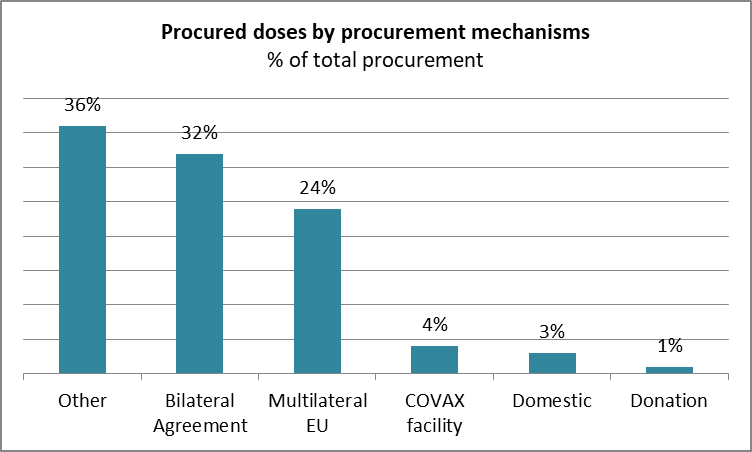
The optimistic target for COVAX was to achieve 20% vaccine coverage through COVAX-secured doses by the end of 2021. So far, COVAX has distributed less than 10% of the total vaccine administered globally. According to WHO data, vaccine procurement is largely done under bilateral (32%) and multilateral (24%) agreements. COVAX facilities account for only 4% of purchase agreements (see figure 2). This underlies the vaccine nationalism and inequality arguments, leaving redistribution to vulnerable LICs as an afterthought. COVAX now mainly coordinates and redistributes vaccines to LICs.
Vaccine doses not administered are vaccines wasted
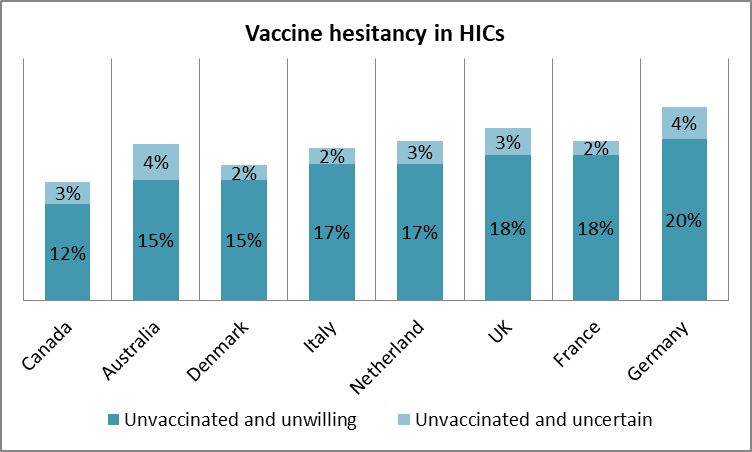
For many HICs, vaccine wastage is partly due to the unwillingness to take the vaccines amongst other issues. In the US, over 15 million doses were wasted since March 2021; France, the UK, and Germany also forecasted high volumes of wastages. By taking a nationalistic approach to vaccine procurement, many countries did not consider the hesitancy that would ensue (see figure 3). Vaccine hesitancy, underlined by the short shelf-life of the vaccines as well as other vaccine administration and policy issues resulted in the observed high vaccine wastages in many countries.
While for HICs, the stockpiling of vaccines for national use and the eventual wastages poses a moral question, for LICs, the story is different. In LICs, vaccine wastage is due to a combination of factors including the short time frame left on donated vaccines, logistical issues and poor infrastructure to deliver vaccination, administrative bottlenecks, vaccine preferences, and hesitancy as well as vaccine racketeering. For instance, in D.R. Congo and Nigeria over 1.7 and 1.1 million doses of vaccines respectively were destroyed due to expiration. Local media reports that the donations were made only a few weeks before the expiry date. As a result, underlined by other logistical and infrastructural bottlenecks, only a fraction of the donated vaccines could be administered. In Kenya, corrupt officials are diverting vaccines for auction at $30 – $50; in other instances, vaccination cards are issued for travel purposes to those not vaccinated.
Nonetheless, juxtaposed with the huge vaccination gaps globally, vaccine wastage is an irony. The excess in the global north is the lack thereof in the global south. A WHO report showed that ninety-eight countries have not vaccinated 40% of their population, and in Sub-Saharan Africa, the vaccination rate is less than 15%. Even though vaccine production has improved (21 approved vaccines) since the rollout in January 2021, vaccines are not distributed fairly and equitably. For instance, less than one in ten health and care workers (HCW) have been fully vaccinated in the African region while four in five have been vaccinated in 22 mostly HICs. Meanwhile, 15 times as many booster doses are currently being administered globally as are primary doses in LICs.
Going forward
COVAX has been working to improve distribution and reduce wastage (to acceptable limits ~5%). To minimize wastage in LICs, COVAX now tries to access the country’s needs for vaccination vis-à-vis their absorptive capacity to distribute and administer vaccines at a level that minimizes wastage. In October 2021, WHO released the Strategy to Achieve Global COVID-19 Vaccination by Mid-2022 with an expanded target to achieve 40% total population coverage by the end of 2021, and 70% total population coverage by mid-2022. Even though the target was not achieved in 2021, with improvement in vaccine production in 2022 and an extensive collaboration amongst HICs, COVAX, pharmaceutical companies, and LICs, it may be possible to surpass the target by the end of 2022.
Currently, governments and firms are resorting to strict vaccine mandate to increase vaccination (for example, Austria, Ecuador, MTN, Citi group). But such strategies can cause massive pushback protests which reverse the gains and increase infections. Therefore, it may be better to be more tactical, use communication and counter-narratives to diminish the spread of anti-vaccine theories. The use of key local stakeholders and trust institutions such as religious houses and family heads may be effective. Vaccine officers must be informed to give vaccination and then register all individuals who present themselves for vaccination. In Nigeria, people have been denied vaccination because they were not pre-registered or scheduled.
[vc_row][vc_column][vc_empty_space height=”80px”][/vc_column][/vc_row][vc_row][vc_column width=”1/4″][vc_column_text]
Ikechukwu Okafor
[/vc_column_text][vc_single_image image=”13362″ img_size=”full” alignment=”center”][/vc_column][vc_column width=”3/4″][vc_column_text]Ikechukwu has over 10 years of banking experience in branch operations and international money transfers. Until recently, he worked with First Bank of Nigeria Limited as Head Branch Services where he led his teams to grow revenues while ensuring that clients and prospects received excellent experience of the products and services channels.
He grew through the ranks, succeeding in various tasks such as Customer Services, Accounts Management, International Money Transfer (Western Union, MoneyGram, World Remit and RIA) Services, ATM Management, Cash Operations, and Customer Relationship Management, all the while contributing to the digital transition of the Bank. He honed his skills in Management, Banking, Strategic Planning, and Business Relationship Management, through work experience and training.
As a voracious learner, Ik had taken courses and participated in projects on Entrepreneurship, Project Management, Business Operations, Supply Chain Principles, Natural Gas Value Chain, and Data Analytics. He is an Associate Member of the Chartered Institute of Bankers of Nigeria (CIBN) and a Graduate Member of the Nigerian Institute of Management (NIM). He is currently enrolled in an advanced programme on International Energy Economics & Business Administration at the University of Leipzig, Saxony Germany. His research focus is on entrepreneurial opportunities in the energy transition.
He is an ethical professional with eyes for opportunities in Business Process Improvement, Business Operations Management, and Energy Business.
[/vc_column_text][/vc_column][/vc_row][vc_row][vc_column][vc_empty_space height=”80px”][/vc_column][/vc_row]
Until his usurpation on September 5, 2021, Alpha Condé has been the president of Guinea, a West African nation since 2010. President Condé was a human rights professor and activist who fought nearly four decades for democracy in Guinea before his victory at the polls ten years ago. He became the first democratically elected leader after 52 years of dictatorship in Guinea. President Condé is 83 years old and had completed what should have been his last term in office in 2020 according to the constitution at the time.
Last year, the Guinean parliament held a referendum that amended the constitution and extended the presidential term limit to two terms of six years per term—a slight shift from the previous 5-year term. The referendum was held in March 2020, a few months before the general elections in October of the same year. President Conde sought a leeway in the ‘timely’ constitutional amendment to contest a third term in the election. A media report noted that President Condé had hoped that the new constitution would allow him to restart his presidential tenure. This way, he would be looking at another 12 years in office.
Shortly after the referendum, Condé was re-elected president after winning 59.5% of the total votes at the polls in October 2020. He was subsequently inaugurated for a third term (or by his calculation, the first term under the new laws) in November 2020—despite the allegations of electoral malpractices and violence leveled against him by the main opposition, Cellou Dalein Diallo and other contestants.
Guineans have endured a history of authoritarian regimes since their independence in 1958. Condé was the first publicly elected president. It might be interesting to review the socio-economic conditions in Guinea over the last 10 years.
Socio-economic conditions under Condé
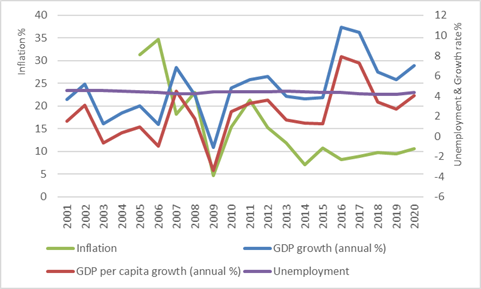
Guinea under Conde has not been as bad (in terms of economic indicators) relative to previous authoritarian regimes. Several economic indicators seem to have improved over the last 10 years—compared to the 10 years before. For instance, Guinea’s gross domestic product (GDP) has been rising following the transition to democracy in 2010. The average growth since Condé’s democracy (2010 – 2020) of 6.2% is higher than that of the previous 10 years under dictatorship – 2.7%. Last year, GDP was $15.68 billion – a 131.1% and 82.4% increase from 2011 and 2016 levels. Figure 1 shows how the growth rate spiked in 2010 and 2016 after Conde’s (re)election in the respective years. Despite the pandemic, GDP recorded a positive growth of 5.2% in 2020. The impressive growth is mostly due to the performance of the extractive sector.
Guinea has significant mineral resource endowments such as bauxite, iron ore, gold, diamonds, and limestone among others. The US Geological Survey data in 2021, reported that Guinea was the second-largest producer of bauxite (82 million tons in 2020) with a proven reserve of 7.4 billion tonnes representing 24.6% of world reserves. According to the African Development Bank’s outlook report 2021, activities in the mining sector grew 18.4% in 2020 from 8% in 2019. World Bank data shows that the rents from minerals have been rising—from 4.45% (2001) to 10.2% of GDP in 2018. Mining accounts for 35% of GDP. China is a major trading partner.
In the labour market, World Bank data shows an average unemployment rate of 4.4% since 2001, lower than the Sub-Saharan (SSA) average of 6.1%. Youth unemployment is however slightly higher at 5.4% (SSA: 11.9%). Agriculture is the main employer of labour accounting for 63.9% of employment. Like other indicators, the price level has fluctuated through the years since 2005; there has been some moderation since 2012 (see figure 1). Last year, inflation was 10.6% (2019: 9.5%).
In summary, Condé’s administration had some positive impact at least on the macroeconomy. It implies that Conde’s democratic regime outperformed the dictatorship regime before him. However, it does not imply that Condé’s regime was the best it could have been. For instance, Guinea remains one of the poorest countries in the world with a per capita GDP of less than US $1000 in 2020. A recent report by the World Food Program showed that 55% of the population live below the poverty line – a sharp increase from 36.1% in 2012. The outbreak of Ebola and Covid-19 worsened living conditions as food insecurity for households was at 21% while 24.4% of infants suffer severe malnutrition. World Bank shows that only about 36% of the population live in urban centres and 50.1% of the urban population live in slums. The exchange rate to the dollar has depreciated 91.3% since Condé took office in 2010. Currently, one US dollar is worth over 9,100 Guinean francs. Guinea is import-dependent as imports of goods and services account for 42.3% of GDP in 2019. Thus, one could argue that economic growth during Condé’s administration was not so inclusive.
In the Human Development Index (HDI) report 2020, Guinea ranked 178 out of 189 – the same rank it had in 2011. Guinea’s HDI of 0.477 in 2019 is below the average of 0.513 for countries in the low human development group and below the average of 0.547 for countries in Sub-Saharan Africa. HDI is a measure for assessing long-term progress in three basic dimensions of human development: a long and healthy life, access to knowledge, and a decent standard of living.
Post-Conde Guinea: Autocracy or democracy?
Since independence from France in 1958, Guinea has been through three dictatorship regimes that ended only after the demise of the dictators. So far, regime changes have been effected through coups. Alpha Condé must have been aware of this pattern and perhaps intended to remain in power for as long.
President Condé, like many African freedom fighters in his time who became dictators, seems to dwell on a certain entitlement (akin to the divine right of Kings) to potentate themselves in power. These autocrats claim to embody a mission only they have the vision to accomplish, clinging unto power, taking out opposition, and suppressing dissent. This entitlement seems to come from the struggles and sacrifices they underwent for the emancipation of the people. The longer they remain in power, the harder it is for them to relinquish it. By altering the constitution to suit his agenda, Condé envisioned at least another 12 years in power, but by raising the budgets of the presidency and parliamentarians at the expense of the civil servants, Condé bit more than he could chew.
Mamady Doumbouya, leader of the palace coup, was a close ally of Condé and the leader of the special forces. Like Condé, he is from the Malinke ethnic group – a fact that diminishes any perspective of ethnic rivalry. Colonel Doumbouya was a legionary in the French Army before returning in 2018 to lead the Special Forces Group in Guinea. Doumbouya was close to government officials as the leader of the special forces; it was, therefore, easy for him to execute a coup. Doumbouya, in his address to the public, claimed a sense of duty to the people was the reason behind the action to halt the authoritarian inclines of President Conde. Even though he restates his commitment to return to civil rule. it is still uncertain how the transition would be conducted. Therefore, the socio-political future of Guineans remains hazy at this point.
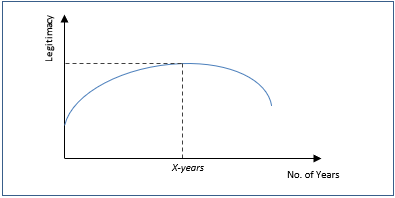
Nonetheless, Doumbouya has not acted differently from putsch leaders throughout history. Typically, putschists intend to change the status quo citing gross misconduct and corruption as the basis for their actions. But a coup is a shock to the political economy and is never an acceptable method of regime change. The international communities intervene by threatening sanctions, demanding a transition to civil rule. But because the putschists are aware of the consequences of their actions – trials or exile – they avoid this by holding onto power, ensuring a semblance of stability, and gradually winning the legitimacy of the people. The longer the putschist seizes authority, the harder it is for him to relinquish it, and the more acceptance or legitimacy he gets as things douse over time (see figure 2). Then he transitions into a democratic rule and the cycle of quasi-democracy continues.
The question is, how should coups be looked at in the future? Should the international community view palace coups differently? Are palace coups necessary, progressive in the light of prolonged, stubborn dictatorships? Would the outlook be different if a coup is justifiable and the putschists complete a handover process to civil rule? Can coups be justified? What is the implication of such a stance on authoritarian stability elsewhere? What is the situation in the Gambia, Zimbabwe, Libya, and other countries where coups have taken place? What are the alternatives to remove an authoritarian leader who has potentate himself beyond the constitutional limit? Doumbouya seems to enjoy support from Guineans: should the opinions of the citizens matter in such cases?
Coups are supposed to be moribund but seem to be gaining application in recent times. In 2021 alone, Mali and Niger have had attempts at coups; and in Chad, after the death of Idriss Deby Itno, the Chadian Army installed his son, Mahamat Deby as the interim leader. Other recent examples include Sudan (2019), Zimbabwe (2017), and outside Africa, Myanmar in 2021. Coups were common methods of regime changes in many African countries in the years after independence. It has become critical to revisit the implications of coups for regime changes, especially under authoritarian rule.
[vc_row][vc_column][vc_empty_space height=”80px”][/vc_column][/vc_row][vc_row][vc_column width=”1/4″][vc_column_text]
Gideon Ndubuisi, Ph.D
[/vc_column_text][vc_single_image image=”12948″ img_size=”full” alignment=”center”][/vc_column][vc_column width=”3/4″][vc_column_text]
Gideon is a Project Manager and Researcher at the German Development Institute (d.i.e) in Germany. He obtained a Ph.D. degree in Economics at Maastricht University (Netherlands).
Gideon has over six years of teaching, research, and consulting experience in Economics. He garnered this experience from working for different reputable local and international organizations such as the German Institute for Economic Research (DIW, Germany), Institute for World Economy (IfW, Germany), European Center for Economic Research (ZEW, Germany), United Nations Industrial Development Organization (UNIDO, Austria), African Development Bank (AfDB, Cote d’Ivoire), United Nation University-World Institute for Development Economics Research (UNU-WIDER, Finland), European Commission (EU-JRC, Belgium), UNU–MERIT/Maastricht University (Netherlands), and NODAC Consulting (Nigeria).
Gideon’s primary research interests are international trade, GVC, formal and informal institutions, firm behavior and performance, and structural change. However, he also researches broadly on development economics-related issues such as international migration, remittance, and entrepreneurship.
[/vc_column_text][/vc_column][/vc_row][vc_row][vc_column][vc_empty_space height=”80px”][/vc_column][/vc_row]
[vc_row][vc_column][vc_empty_space height=”80px”][/vc_column][/vc_row][vc_row][vc_column width=”1/4″][vc_column_text]
Uju Ikedionu-Obichukwu
[/vc_column_text][vc_single_image image=”12949″ img_size=”full” alignment=”center”][/vc_column][vc_column width=”3/4″][vc_column_text]
Uju works with Allianz Insurance Nigeria as a Reconciliation Officer. Before joining Allianz, Uju worked as a research and data analyst at BusinessDay Research and Intelligence Unit (BRIU), a subsidiary of BusinessDay Media Ltd. In that capacity, she contributed extensive research on corporate governance, sustainability, and aviation industry report. With a bachelor’s degree in Economics from Obafemi Awolowo University, Uju has received training on basic financial modeling and forecasting, Economic modeling, valuation, and tools in accounting and macro-economic analysis.
Her interests span Financial analyses, investment banking, impact investing, corporate sustainability, and corporate governance.
[/vc_column_text][/vc_column][/vc_row][vc_row][vc_column][vc_empty_space height=”80px”][/vc_column][/vc_row]
[vc_row][vc_column][vc_empty_space height=”80px”][/vc_column][/vc_row][vc_row][vc_column width=”1/4″][vc_column_text]
Chukwuma Dim, Ph.D.
[/vc_column_text][vc_single_image image=”12364″ img_size=”full” alignment=”center”][/vc_column][vc_column width=”3/4″][vc_column_text]
Chukwuma holds a doctorate in Finance from the Frankfurt School of Finance and Management. He earned a master’s degree in Financial Engineering from Xiamen University, and a bachelor’s degree in Economics from Nnamdi Azikiwe University, Nigeria. Over the years of his study and research, Chukwuma has won several awards and recognition, including the University Anniversary Award for the best graduating international student university-wide, and the School of Economics Excellent Student Award, both from Xiamen University.
[/vc_column_text][vc_column_text]
Chukwuma worked as a Researcher at the Lagos Business School, conducting research on risks in public-private partnerships, infrastructure projects, and evaluation and optimal design of infrastructure industry reforms. Chukwuma also worked as a Financial Analyst at Agusto & Co, where he, amongst other things, conducted risk ratings of Non-Bank Financial Institutions, research and risk ratings on Financial Technology and Solid Minerals industries, as well as target market studies. At Agusto & Co., Chukwuma designed quantitative models for ratings-migration matrix and the probability of default term structure embedded in credit risk management applications. He is currently with George Washington University, USA.
[/vc_column_text][vc_column_text]
Chukwuma’s current research and applied interests cut across asset pricing, quantitative portfolio and risk management, financial markets, and applications of big data in finance and economics.
[/vc_column_text][/vc_column][/vc_row][vc_row][vc_column][vc_empty_space height=”80px”][/vc_column][/vc_row]
I refer to ‘Boyonomics’ as the ideas of Henry Boyo, a Nigerian who has persistently contested the monetary framework of the Central Bank of Nigeria (CBN) since the turn of the millennium. Boyo’s ideas build on the condition in the foreign exchange market where the CBN is the single monopolist. The CBN captures the dollar revenues of the state, converts at a unilateral rate against the Naira, before disbursing to the arms of governments, MDAs and Bureau de Change (BDC). This is equivalent to minting of naira notes (naira flood). Because the dollar revenue which has been captured by the CBN via its monopoly stance creates dollar scarcity, there is a constant devaluation pressure against the naira relative to the dollar. So to ease the pressure on the naira following the naira flood, the CBN intervenes – in the money market – with a ‘mop-stick’ by exchanging promises-to-repay in order to clean up some naira liquidity. This monotonous routine has been the operational framework of the CBN that Boyo vehemently criticizes. He has endured cursory attention – if not outright disregard – by the relevant authorities. He proposed a system that issues dollar certificate to the statutory beneficiaries with which they would offer to buy Naira in the open market such that it would be dollars chasing naira – the currency in demand gains value. But does it translate to value for the naira?
Weaknesses in the Logic
‘Boyonomics’ may not translate to increased value for the naira, rather to correct valuation of the naira at higher exchange rate! For clarity, take the currency as a tradable good paid for with goods/services. Offering a currency in the open market – to compete – implies that it has some values driving its demand. The naira is mostly backed (indirectly) by the extractive industry which is the major foreign exchange earner, but the sector is also the base of the global production value chain; and since naira is not the currency in trade, the value derives from the foreign reserves. It becomes glaring that the naira, beyond the territorial bound in which it is a legal tender, is not as worthy as the digits inscribed on it. This implies that the statutory beneficiaries, who bear these dollar warrants, negotiating from a position of strength, would demand more naira for each dollar under the liberal framework, and the banks, tempted to increase their stock of valuable dollars, would comply! Hence, under the liberalized foreign exchange market, the correct naira valuation would go under at the mercy of the dollars; and the economic woes of devaluation – eroded purchasing power, deplete foreign reserves and stagflation – would lead to suicides and revolution.
Again, assuming the representatives of the statutory beneficiaries are sincere, they would recognise that the critical short supply of infrastructures requires dollar expenditure to close: they would therefore develop preference for higher dollar balances. This implies that only the dollar sum enough to meet the naira denominated recurrent expenditures would be offered in the foreign exchange market. On the private sector side, major exports are extractive based, industries require foreign input – implying that we depend largely on imports for processed goods. All these, denominated by our population make up huge dollar import bills which take tolls on the naira value.
Why the CBN may not float
Dollar Debts: generally, developing countries are not able to borrow in their domestic currencies; and infrastructural gaps imply that they require huge dollar borrowings to buy foreign technologies to minimize gaps. These liabilities are denominated in foreign currencies whereas assets are denominated in naira. In the event of shocks, a depreciation in local currency could have a devastating balance sheet effect that dwarfs the assets side (in naira) relative to the liability side (in dollars), crippling the entire financial system. Also, it becomes even more expensive in terms of naira to repay foreign debts.
Credibility of the CBN: ensuring price stability is a statutory responsibility of the CBN. A credible central banker would want to stick to announcements about inflation targets. Therefore, the CBN, in a given period, sets a target on inflation under a loss minimization program. But because economic agents are rational, they would form expectations and engage in contracts which make the initial policy announcements of the monetary institution sub-optimal. Therefore, the central authority, in order to increase welfare (employment) along the Philips curve, deviates from announcement, creating surprise inflation. The implication here is that sustained inflation may not be the result of irrational policy decision of the central bankers but reflects their inability to commit to policy announcement due to the rational expectations of private agents. This means that the exchange rate volatility in a float system has a pass-through effect on inflation and interest rates which challenges the credibility of the CBN to stick to rules on inflation target.
Dollarization: floating the exchange rate would lead to massive devaluation of the domestic currency as we saw in the last attempt by the CBN to liberalize the market in 2016/2017. Foreign goods would become more expensive, inflation bolts in: as the naira loses value, importers would develop preference for (increasingly) scarce dollars so as to reduce the transaction costs of exchanging currencies. This would weaken even more the naira fiat, making way for the dollar as the currency in trade, superior to the naira. If this is the case, it weakens the ability of the CBN to use monetary instruments. There is the argument about the counterbalancing effect of devaluation which increases exports revenues via the price and quantity effect such that devaluation means well if the Marshall-Lerner condition holds. But are we a net exporter by balance of trade?
In conclusion, initial devaluation and uncertainty in real exchange rate bear significant output costs via reduction in investments. However, the essence of this argument is not to discredit the efforts and ideas of the man in almost twenty years, but rather to glorify his persistence with an objective response based on the principles of economics. It is possible for the CBN to run simulations based on the idea, followed by a trial depending on the results of the simulation. He deserves recognition, if not an award.
For a developing country, debt accumulation is inevitable for national governments. Government spending is typically financed by government borrowing – externally and domestically – and by raising taxes. However, it is equally vital to have a sustainable debt management framework so as to avoid over-borrowing. National and sub-national governments must incorporate some kind of inter-temporal framework in their borrowing strategy such that consumption today does not mean liability for tomorrow’s generation.
In Nigeria, the Debt Management Office is the institution saddled with the responsibility of managing the nation’s sovereign debts. Periodically, it conducts stress tests to ascertain the sustainability of the debt stock against the prevailing macroeconomic environment and the scenarios in the domestic (debt) market.
The last Debt Sustainability Analysis conducted in 2017 by the DMO adopted the latest version of the joint World Bank/IMF Debt Sustainability Framework for Low-Income Countries which provides indicative debt thresholds that reflect the quality of a country’s policies and institutions. It is based on the World Bank/IMF’s Country Policy and Institutional Assessment (CPIA) index ranking which classifies countries into one of the three policy performance categories: Weak Policy (CPIA<3.25); Medium Policy (3.25≤CPIA≤3.75) and Strong Policy (CPIA >3.75), and applies different indicative debt thresholds, depending on the performance category. Along with such countries as Ghana, Mozambique, Ethiopia and Sierra Leone, Nigeria is classified as a medium performer on the CPIA index with a score of 3.41.
The 2017 DSA included a stress test for the economy under three scenarios: the baseline scenario which hinges on assumptions of the annual budget and the medium-term expenditure framework (MTEF) 2018-2020; the optimistic scenario anchors on the optimism of the Economic Recovery and Growth Plan (ERGP) with a target growth rate of 4.80% in 2018 and 7% by 2020; while the pessimistic scenario assumes continued shock to the foreign exchange earner – crude oil – at less than $30pbd, deterioration in the external balance and depreciation of the domestic currency.
Total Public debt stock (H1 2019)
| National debt | 2018 | 2019 | Diffrence | %change |
| Total Public debt (USD ‘bn) | 73.2 | 83.9 | *10.7 | 14.62 |
| External Debt (USD ‘bn) | 22.08 | 27.16 | 5.08 | 23.01 |
| Domestic Debt (NGN ‘trn) | 12.15 | 17.38 | 5.23 | 43.01 |
| Domestic Debt (USD ‘bn)* | 51.12 | 57.74 | 5.62 | 10.99 |
However, since the GDP growth rate has hovered below 2 per cent behind the ERGP optimism of 4.80%, but global oil price has hovered around USD60pb, and the naira exchange rates have been stable at N359/USD1; it may be objective to evaluate based on the baseline scenario since the scenarios in the other extremes have not been experienced.
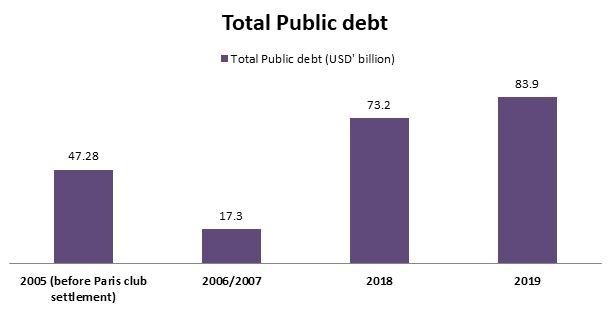
As of June 30 2019, the Debt Management Office (DMO) reported that the debt stock (both national and sub-national) stood at N25.7 trillion (USD83.9 billion)—this represents a 14.6 per cent increase from the preceding year. Of this total, domestic debt accounts for 67.6 per cent (= N17.38 trillion), while external debt standing at N8.32 trillion (USD27.16 billion) accounted for 32.38 per cent.
In 2018, the Debt Management Office (DMO) proposed an extension of the borrowing threshold from 19.39 per cent to 25 per cent. However, with the addition of N10.7 trillion in 2019, Nigeria already surpassed the 25 per cent threshold (see Table 1). Figure 1 shows that since-after the Paris club debt write off, the nation’s public debt stock has risen by over USD65 billion – more than twice the debt written off. The DMO also adopted a strategy to increase the ratio of domestic to foreign debt as a cushion to external (foreign currency) shocks. Table 1 shows, however, that the rate of change of domestic debt is lower (11 per cent) in terms of the foreign currency than in domestic currency (N43.1 per cent). This would be due to the exchange rate effect. Should the DMO revise or revisit its debt strategy?
Sinking Funds
In the first half of 2019, the total amount of external debt servicing and interest payment on domestic instruments amounted USD 609.56 million and NGN800.11 billion respectively. These values are 2.2 per cent and 4.6 per cent of their corresponding total. Commercial papers and Eurobonds took 62.2 per cent of the total debt service funds while bilateral debts got the least – 3.4 per cent in Q2 2019.
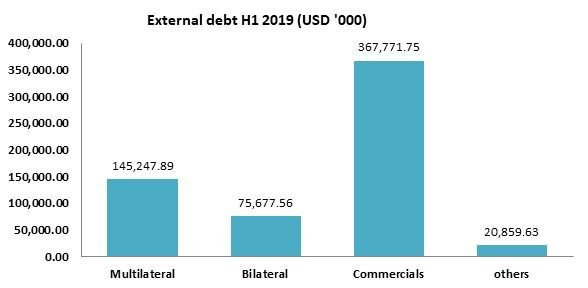
For domestic debts servicing, FGN bonds claimed more than half of the total interest repayment in the first half of 2019; whereas FGN savings bond had the least with NGN658.54 million. From the table, most of the repayments were done in the first quarter of 2019 valued at NGN610.3 billion – representing 76.3 per cent of the total. And the FGN bond took NGN 480.85 billion.
Table 3 External Debt H1 2019 (USD’ 000)
| External Debt H1 2019 | |||||
| Debt servicing | Q1 2019 | Q2 2019 | Q1 % of total | Q2 % of total | H1 2019 |
| Multilateral | 79,397.93 | 65,849.96 | 22.23% | 26.10% | 145,247.89 |
| Bilateral | 67,099.39 | 8,578.17 | 18.78% | 3.40% | 75,677.56 |
| Commercial/E-bond | 210,759.58 | 157,012.17 | 58.99% | 62.23% | 367,771.75 |
| others | 20,859.63 | 8.27% | 20,859.63 | ||
| Total | 357,256.90 | 252,299.93 | 100% | 100% | 609,556.83 |
Table 4 Domestic Debt H1 2019
| Int. on instruments | Q1 N’bn | Q2 N’bn | H1 N’bn |
| NTBs | 120.92 | 45.71 | 166.63 |
| Treasury Bonds | 6.25 | 6.25 | |
| FGN Bonds | 480.85 | 128.99 | 609.84 |
| FGN Savings Bonds (N’Mn) | 347.92 | 310.62 | 658.54 |
| FGN SUKUK | 8.17 | 7.85 | 16.02 |
| FGN Green Bond (N’Mn) | 718.53 | 718.53 | |
| Total | 610.28 | 189.83 | 800.11 |
Conclusion
The year 2019 has been an interesting time. Macroeconomic indicators are not impressive: inflation is above 11 per cent, GDP growth less than 2 per cent, unemployment is high above 25 per cent and debt and debt servicing continues to hover over the bars. Increased government presence in the debt market would crowd-out private sector investments and matters would be debilitating. Recently, the Central Bank of Nigeria restricted the purchase of its OMO bills to banking institutions and Foreign Portfolio Investors (FPI) in a bid to re-channel funds away from risk-free assets to real sector investments. This is expected to moderate yield environment and reallocated resources to growth sectors. However, monetary institutions have to be strategic going into the New Year to hedge against external shocks and other fundamental uncertainties.
Not all statistics are worth losing sleep over. Some are just for the informational content. The home-ownership rate is one such: it is a measure of the proportion of people who live in their own houses. It indicates the strength of mortgage market and at best, a measure of aggregate prosperity. When it is low, it implies that something has to be done to increase prosperity – not home-ownership per se – in the expectation that prosperity would bring the wealth and motives to acquire homes. However, at some point in our development path, we took the wrong approach towards increasing the level of home-ownership. The government, instead of investing in housing, conducted ‘fire sales’ of public lands to the highest bidders, increasing the relative scarcity of land and its prices. Soon, everyone wanted to own lands, it had become popular as the ‘best investment’ irrespective of its high capital-output ratio. Private individuals flooded the housing market. The government eventually exited the market as it became difficult to regulate.
Today, the effects of this unstructured deregulation include illegal sales, land grabbing, collapse of urban planning, rise in squatter settlements, unhealthy competition for lands, uncontrolled factor pricing, cost-push inflation, and rising housing deficit. These made other public infrastructure – water, sewage system, and transportation – necessary for urban planning almost impossible to develop. This approach to increase the rate of home-ownership does not reduce the rate of homelessness, rather increases it.
There is a housing deficit of about 17 million. It would take the production of one million units per annum over a 20 year period to close this gap. But overall annual fulfilment is 100,000 units and a corresponding deficit of 900,000 units which carries a potential cost of US$ 16 million. The mortgage market is somewhat labyrinthine with 57 players, but mortgage financing to GDP is 0.58% (South Africa, 31%), home-ownership is 24% (Kenya, 73%). Mortgage conditions are stringent: interest rates are as high as 20% and a 25% down payment on an average mortgage size of US$ 18,000 – in country where 87 million people live below US$ 1/day. The focus should be eradicating extreme poverty not increasing home-ownership.
Presented with evidence of market failure, the visible hand of government is necessary to restore equitable distribution and social optimum in the housing market. But governments too have failed.
A number of state governments have attempted mass housing schemes: it is typically a few blocks of bungalow houses built in remote locations, deserted and often unliveable to those for whom they were intended. And when these governments realize their failures, they enter into a quasi-partnership with government compradors who connive with other individuals, in the guise of estate developers, to off-take the lands being sold out by government ministries and local communities under shady negotiations – with no pretension to transparent market process. These pseudo-developers go on to build luxury houses for themselves and the upper class. No consideration for the vast poorly-housed lower class. Ogun state is a classic case: the government and communities are off-loading the lands to churches, private developers and foreign businesses in a fate of competition with Lagos state, ignorant of the current challenges Lagos state faces. They are losing the opportunity as a sparsely populated state to initiate integrated city development.
So while these estate developers continue to build for the top 1 per cent that could afford home-ownership and already own estates, nobody builds for the ordinary man. A subtle paradox ensues: a simultaneous development of luxury estates and slum estates; whereas the former is largely unoccupied, the latter is overcrowded. The results of markets is not always optimal: no wonder while there are slum cities to revamp, scarce resources were rather directed towards building a new luxurious Eko-Atlantic city despite the number of unoccupied apartments in Ikoyi, Victoria Island and the environs. It was only recently that we realized that these empty buildings served other purposes as cash vaults to hide away stolen monies. This partly explains why rental prices are downwardly rigid in these environs where there is a glut of albeit, luxury homes.
Housing, like education and health is a critical sector in which the government cannot laissez-faire. The high capital-output ratio in housing investments implies that unchecked markets would not yield socially optimum outcome. The visible hand of government is necessary both as a player and regulator to steer the market to desirable outcome. Housing is a major part of household consumption and savings motives in developing countries. Therefore, improving housing conditions would have positive implications for standard of living.
Concluding remarks
Sadly the housing production model continues to be about luxury homes even though it is not working! The diaspora city plan of the Federal Housing Authority to build estates for Nigerians living outside of Nigeria is a case of government betrayal of the majority of Nigerians living in Nigeria with no decent roof over their heads. Government needs to return to the market: they need to increase the percentage of total land stock in the government’s possession even if it means revoking certain land titles. They need to provide proper incentives to local authorities, housing associations, private establishments and community organizations that have the resources and can endure the long-term risk-return nature of housing investments to produce standard rental units at affordable prices. Housing units could be built and then sold apartment by apartment in which case the overall assets still remains in public ownership, allowing therefore for integrated maintenance and urban planning. This was the Jakande model in 1983 Lagos state. These sorts of collaboration and coordination are necessary to correct the market distortions and provide affordable homes for Nigerians. However, the rhetoric needs to be changed: everybody cannot be homeowners. Therefore, there should be provision of a minimum standard of housing unit for life-starters and those who cannot afford luxury home-ownership.
(First published: https://www.businessdayonline.com/exclusives/analysis-sub/article/need-visible-hands-affordable-housing-market/)