Too frequently, Nigerians across the country suffer severe hardship due to the scarcity of petroleum products, especially premium motor spirit (PMS). The most recent episode of PMS scarcity lingered through the tail end of 2022 into the first quarter of 2023. Despite the government’s assurances that there were enough petroleum products in stock, the scarcity persisted amid a poor electricity supply. Businesses and households had to choose between standing long hours in queues to get a rationed quantity of PMS or depending on erratic power supply from the national grid. Last year, the national grid collapsed multiple times causing total blackouts in many parts of the country. Petrol-fired generators are a common source of independent power production for households and businesses in Nigeria.
Public transportation is one of the hard-hit sectors during each episode of scarcity: private cars, commercial vehicles and motorcycles combine with individuals to create a desperate mob seeking to get ahead to buy petrol. As the scarcity lingered, the cost of a litre of petrol rose uncontrollably to N500 per litre in some parts of the country – the official petrol price moved up to N185 from N175 per litre. Soon, there were black market dealers reselling petrol at a premium across major cities in Nigeria. This would have cost-push implications for general price levels. The cost of petrol, through transport costs, is a driver of inflation in Nigeria.
What are the issues?
There are several factors responsible for this anomaly. From inadequate refining capacity to challenges with distribution, bunkering, systemic corruption, and political instability, the challenges facing Nigeria’s petrol sector are multifaceted and deeply entrenched. But I reviewed these issues from the economic dimensions of price, supply and demand.
Unstable price
Nigeria is an oil-producing nation but has no functional refinery. Therefore, it imports most of its refined petroleum products. This has exposed the country to the uncertainties of international crude-oil pricing. This is amplified in this period of global energy crisis occasioned by the Russia-Ukraine conflict. As the prices of imported refined products go up, the pump price of petrol and other by-products go up; it passes through transport costs to have a cost-push impact on the general price level. Also, the national debate on subsidy removal creates market uncertainties that mar price signals. Nigerians are now looking forward to how the new Dangote refinery would impact the domestic price of petrol.
Faltering Supply side
The lack of adequate investment in the downstream sector has made it difficult to meet the local supply requirements. Over the years, there has been a paucity of new investments in refining, distribution and storage facilities due to policy inconsistencies. Although the new Petroleum Industry Act 2021 was expected to address this, the impact of proper implementation is not yet strong enough to lure private capital to the sector. No doubt we have seen some projects coming up, but the scale needed to bridge the supply gap in the shortest possible time is still missing.
The 4 sick sisters which are government-owned refineries have been out of operation for several years. Nigeria has had to import refined products from abroad after exporting crude oil. This situation exposes the economy to exogenous shocks in the oil market. Yet, with a combined capacity to refine 445,000 barrels of crude oil per day, the four local refineries continue to incur annual operational costs without refining a single barrel of crude oil. According to an audited statement of the Nigerian National Petroleum Cooperation (NNPC) Limited, the refineries did not record any revenue in 2021 but incurred a comprehensive loss of N69 billion.
Corruption in subsidy management makes the entire business chain less transparent. While the landing cost of petrol is currently estimated at N400/litre, the Federal Government (FG) mandates marketers to sell at N185/litre through its subsidy programme. However, the dwindling revenues vis-à-vis foreign exchange shortfall make it difficult for the FG to sustain the subsidy on PMS consumption. The FG has mulled over the removal of subsidies over the years. It is apprehensive of the citizens’ negative reactions as there could be some immediate adverse economic implications especially for the bottom of the pyramid if not properly coordinated. Subsidy payments in the sector have been fraught with monumental fraud over the years. Several organizations were indicted for receiving payments for petrol not supplied yet no one has been punished. With prices ranging from N195 to N400 in different parts of the country a few months ago, one wonders if the subsidies are still in effect.
The thriving business of smuggling refined products also stokes petrol scarcity in Nigeria while indiscriminately increasing the government’s subsidy bill. It is estimated that about 30 million litres of petrol per day are smuggled across Nigeria’s borders to neighbouring countries. A major incentive exists for smuggling due to the significant price disparity between Nigeria and its neighbours. While petrol was selling for N175/litre in Nigeria before the current fuel scarcity, it sold for between N400/litre and N500/litre in border countries like Benin and Niger Republics. The high price differentials create room for smuggling to these neighbouring countries.
Bloating Demand side. What is increasing the demand?
In 2020, the NNPC reported an anticipated increase in demand for petroleum products in Nigeria from 15.1 million metric tonnes (MT) to 17.3 million MT, an increase of 14.6%. Curiously, there was no correlated corresponding increase in economic activities during this period. However, some developments are responsible for the increasing demand most of which have not attracted much attention in public discourse.
The erratic electricity supply situation in Nigeria is endemic. It has one of the greatest grid instabilities in the world. The country has struggled with poor power supply for years, often caused by generation and transmission problems. The national grid collapsed multiple times last year alone. As a result, many Nigerians depend on power generators. These generators are mostly powered with PMS which aggregately increases the demand for PMS by both businesses and households. Without commensurate supply, scarcity often ensues.
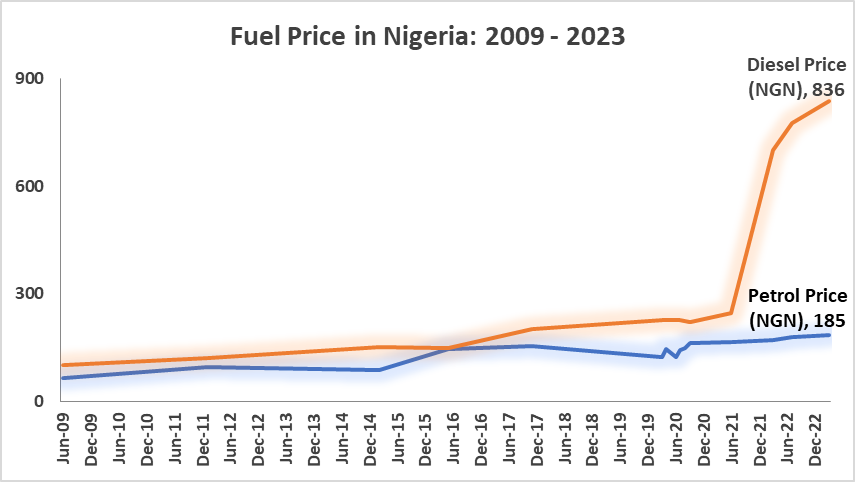
After the deregulation of the diesel market in 2009, the price rose gradually from about NGN90 in September 2009 to about NGN300 in December 2021, then steeply spiked to NGN800 as of November 2022 (see the figure below). Since diesel is used by many commercial enterprises, this sharp increase has driven up the operating costs of many businesses, prompting diesel users to seek alternative sources, especially PMS and solar. The net implication is a rise in demand for PMS.
Petrol-for-diesel fuel switch has not been given much attention. Fuel switching simply refers to the course of changing the fuel source used for energy-consuming activities. This can involve switching from one type of fossil fuel to another or from fossil fuels to renewable energy. Fuel switching is often done for environmental reasons, such as to reduce greenhouse gas emissions, but it can also be driven by economic factors, such as fluctuations in the price of different types of fuel. Since the hike in the price of diesel following the deregulation, PMS has become relatively cheaper due to the retained consumption subsidy from the government. Consequently, large households and businesses inevitably switched to PMS to power their backup generators. Many users abandoned their diesel generators for petrol-powered ones thus increasing the demand for petrol.
The graph shows a spike in diesel prices in March 2022 at the height of the energy crisis induced by the Russian-Ukraine war. Source: Nigeria Bureau of Statistics
So, are there any possible solutions?
The effects of the fuel shortage on Nigerians are numerous. Economic activities are usually paralyzed and the burden is mostly borne by people at the bottom of the pyramid. It slows down business activities as prices go up and both businesses and households tend to postpone spending decisions until prices normalize. At other times, it leads to mass protests which can get violent and lead to the destruction of properties and the loss of lives. But for how long can this continue? I discuss some ways out of the woods below.
Concerted efforts must be made to attract private investments in the downstream business. Moving from a heavily regulated regime to a deregulated private sector regime is a challenge. Perhaps the PIA is not getting the needed publicity, especially in the international scene to attract foreign capital flows. Increasing investments in the local supply chain and improving capabilities will surely translate to improved supply. All eyes are on the Dangote refineries.
The development of the Dangote Refineries and other modular refineries.
The Dangote Refinery is expected to eliminate the importation of petroleum products; saving about $50 billion in annual imports. The refinery, which was commissioned on 22 May 2023, by the outgoing President Buhari a week before his handover to the incoming president-elect, Bola Tinubu shows the national significance of the Dangote refinery. This single project could drastically improve the supply chain bottlenecks, cut import bills, engender foreign exchange accretion and reduce the pump price of fuel. The advantages and benefits of local refining could create the grounds for subsidy removal without harshly jeopardizing welfare – if well-coordinated.
The government should also take steps to refurbish the existing refineries in the country by allowing private investments. The process of commercialization and privatization of these assets, like the telecom sector, to credible investors could get us out of the woods. If the local refineries become fully functional, Nigeria could easily become a net exporter of refined products.
Improving the electricity supply, especially to residential and commercial hubs will go directly into reducing the demand for petrol. After all, residential demand for petrol-to-power is a major factor driving up petrol consumption. By increasing electricity generation and enhancing transmission and distribution systems, petrol demand would be reduced by more than half. Again, if there was any time that renewable energy needed to be given more attention, that time is now.
Is subsidy ever a good idea? Despite the position of the Brenton Woods institutions, western countries still apply subsidies to support particular sectors, especially at critical times. For instance, many countries in Europe increased subsidies on public transportation at the peak of the recent global energy crises conditioned by the Russian war in Ukraine.
For Nigeria, the government could create conditions to boost the local production of petrol and redirect subsidies to welfare-enhancing areas of the economy. One way to do this is to open up the sector to credible private investments in oil refining, increase production and supply capacity, and reduce demand for refined products by boosting electricity generation and reducing transportation demand for petrol by creating a healthy public transport system). The subsidy may then be applied to public transportation. To remove subsidies without backlash, we must reduce residential PMS demand and moderate prices by improving grid electricity supply.
The way forward
The deregulation of the downstream sector remains a potent and lasting solution to petrol scarcity, in the hope that it attracts investments to the sector to boost supply. The government must revamp or privatize the existing refineries as it simultaneously encourages investments in the downstream sector. We need to have smaller pockets of Dangote refineries across the countries, and the goal should be to become a net exporter of refined petroleum products over the next 10 years.
In the long term, there must be a shift in paradigm in our energy security strategy if we are to avoid energy crises in the future. We must adopt multiple approaches like diversifying the energy mix through private sector investments, modernising energy infrastructure to include smart grid solutions and green buildings and promoting energy efficiency measures aimed at reducing demand. Simple solutions, such as using energy-efficient appliances in buildings will go a long way.
No thanks to the wrong political and economic choices of the last decades, Nigerians have been plunged into multidimensional poverty. Nigerians are facing scarcity on many fronts: food, Jobs, energy, and recently, naira scarcity due to the attempt by the Central Bank to demonetize the economy. We are running on empty. The incoming administration must be innovative on all fronts to steer the local economy out of the slow economic growth. Efforts must be concerted to tackle energy scarcity and poor energy infrastructure to support SME growth and enhance the quality of life in Nigeria. While countries are gravitating towards green, clean energy alternatives, we are still grappling with distributing dirty fuels. Nonetheless, energy assurance is critical for the development of any nation. Economic advancement is hardly possible without access to sufficient energy.
The distribution and administration of Covid-19 vaccines are creating unpalatable challenges. On one hand, high-income countries (HICs) are circumventing COVAX, a coalition established to coordinate the equitable distribution of COVID-19 vaccines globally, to enter direct purchase agreements with big pharmaceuticals. The result is the inequitable access to vaccines to low-income countries (LICs) and the continued spread of the mutating virus. On the other hand, anti-vaccination propaganda has caused tremendous vaccine hesitancy and wastage across the world even more so in the HICs where they have stockpiled more vaccines than necessary.
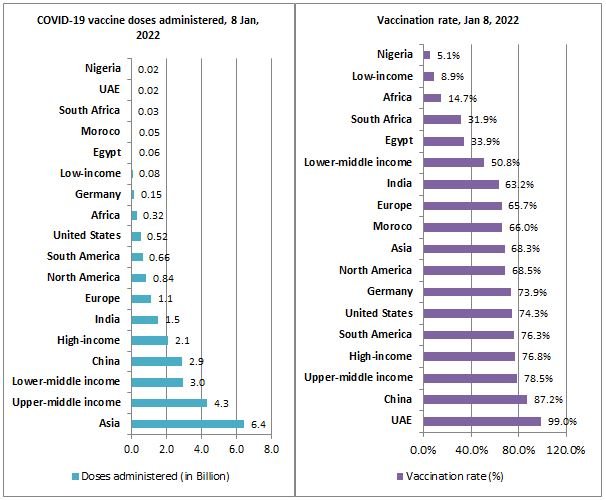
The WHO vaccination data shows that over 17.2 billion vaccine doses have been procured globally. According to data from Our World in Data, about 9.4 billion doses have been administered – representing 54.7% of procured vaccines. As of January 8, 2022, total administered doses represent 59.1% of the global population, of which 49.93% are fully vaccinated and 9.15% are partially vaccinated. HICs and upper-middle-income countries (UMICs) have achieved comparatively high vaccination rates (see figure 1). Figure 1 shows that HICS and UMICs have administered at least 20 times more vaccines than in LICs. Countries such as China, UAE, the US, and Germany have higher vaccination rates than LICs and Africa.
Figure 1: COVID-19 Vaccine doses administered. Source: Our World in Data
In Africa, the vaccination rate is low compared to other regions – 14.7% (see figure 1). Vaccination in Africa accounts for only 3.3% of vaccines administered globally. The Africa Centre for Disease Control data shows that 58.7% of total vaccines supplied were administered as of 5 January 2022. The total vaccine doses supplied was about 546.7 million doses – roughly 3.1% of global vaccine procurement. As of January 5, 2022, the share of fully vaccinated people was 9.6%; the share of partially vaccinated was 5.1% while booster shots administered was 0.35% of the population. The data shows that Africa lags in terms of total vaccination rate compared to America (72.4%), Asia (68.3%), and Europe (65.7%).
At less than 15% one year after vaccine rollout, LICs show a very slow vaccination rate. This poor vaccination performance is due largely to countries in Sub-Saharan Africa such as Burundi (0.05%), D.R. Congo (0.3%), Chad (1.7%), South Sudan (2.1%), Eritrea (no vaccination), and other countries such as Haiti (1.1%) and Yemen (1.9%). Whilst LICs struggle to meet vaccination targets, high-income countries (HICs) are surpassing their targets, delivering vaccine booster shots against mutating variants of the virus and vaccinating children. Throughout 2021, more booster doses were administered in HICs than the vaccine doses in LICs. This phenomenon has been described as vaccine inequality. Vaccine inequality is due mainly to vaccine nationalism – a situation where national governments exploit bilateral agreements or export restrictions to secure vaccines in advance for their nationals to the detriment of other countries.
In the early stages of vaccine production, many HICs and middle-income countries (MICs) entered bilateral and multilateral arrangements with pharmaceutical companies to secure surplus quantities of vaccines for their population. The result is an inequitable distribution and access to vaccines and an overall inability to collectively tackle variants of the Coronavirus. The World Health Organization (WHO) warned against such a nationalistic approach to vaccine distribution and formed COVAX in alliance with GAVI, the Vaccine Alliance, and the Coalition for Epidemic Preparedness Innovations (CEPI). COVAX was envisioned to be the primary distributor of COVID-19 vaccines globally to guarantee fair and equitable distribution and access to COVID-19 vaccines for every country in the world. Within COVAX, the Independent Allocation of Vaccines Group (IAVG) serves as an independent referee for a needs-based allocation of vaccines. However, rich nations largely sidestepped COVAX, hoarding doses for their populations and cutting deals directly with LICs and MICs.
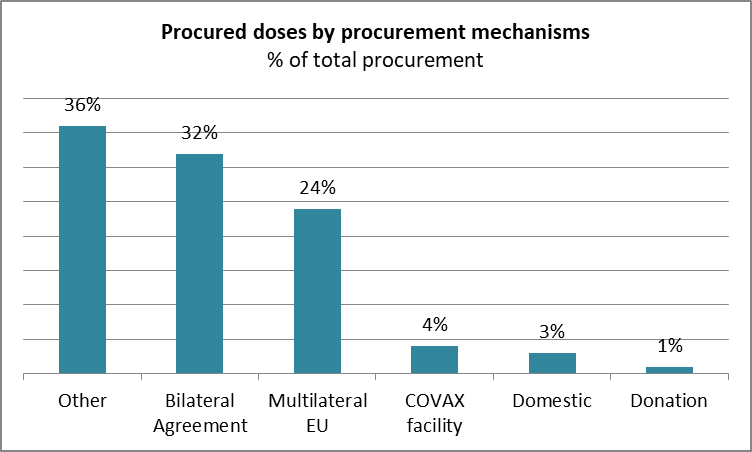
The optimistic target for COVAX was to achieve 20% vaccine coverage through COVAX-secured doses by the end of 2021. So far, COVAX has distributed less than 10% of the total vaccine administered globally. According to WHO data, vaccine procurement is largely done under bilateral (32%) and multilateral (24%) agreements. COVAX facilities account for only 4% of purchase agreements (see figure 2). This underlies the vaccine nationalism and inequality arguments, leaving redistribution to vulnerable LICs as an afterthought. COVAX now mainly coordinates and redistributes vaccines to LICs.
Figure 2: Share of vaccine procurement mechanisms. Source: WHO COVID-19 dashboard
Vaccine doses not administered are vaccines wasted
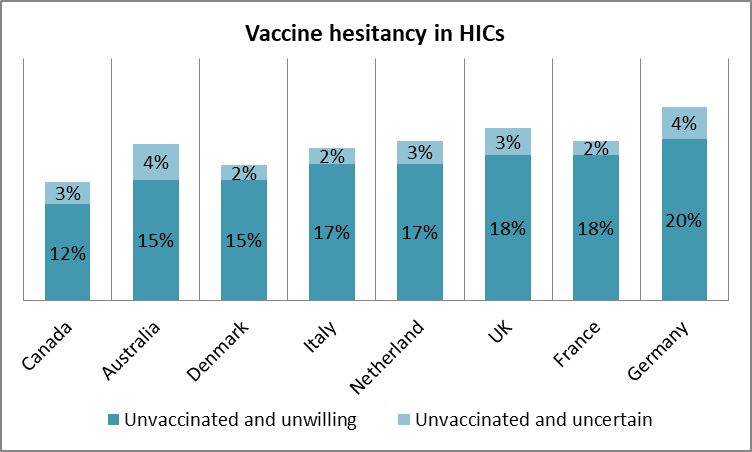
For many HICs, vaccine wastage is partly due to the unwillingness to take the vaccines amongst other issues. In the US, over 15 million doses were wasted since March 2021; France, theUK, and Germany also forecasted high volumes of wastages. By taking a nationalistic approach to vaccine procurement, many countries did not consider the hesitancy that would ensue (see figure 3). Vaccine hesitancy, underlined by the short shelf-life of the vaccines as well as other vaccine administration and policy issues resulted in the observed high vaccine wastages in many countries.
Figure 3: Survey on (un)willingness to get vaccinated in HICs. Source: Our World in Data
While for HICs, the stockpiling of vaccines for national use and the eventual wastages poses a moral question, for LICs, the story is different. In LICs, vaccine wastage is due to a combination of factors including the short time frame left on donated vaccines, logistical issues and poor infrastructure to deliver vaccination, administrative bottlenecks, vaccine preferences, and hesitancy as well as vaccine racketeering. For instance, in D.R. Congo and Nigeria over 1.7 and 1.1 million doses of vaccines respectively were destroyed due to expiration. Local media reports that the donations were made only a few weeks before the expiry date. As a result, underlined by other logistical and infrastructural bottlenecks, only a fraction of the donated vaccines could be administered. In Kenya, corrupt officials are diverting vaccines for auction at $30 – $50; in other instances, vaccination cards are issued for travel purposes to those not vaccinated.
Nonetheless, juxtaposed with the huge vaccination gaps globally, vaccine wastage is an irony. The excess in the global north is the lack thereof in the global south. A WHO report showed that ninety-eight countries have not vaccinated 40% of their population, and in Sub-Saharan Africa, the vaccination rate is less than 15%. Even though vaccine production has improved (21 approved vaccines) since the rollout in January 2021, vaccines are not distributed fairly and equitably. For instance, less than one in ten health and care workers (HCW) have been fully vaccinated in the African region while four in five have been vaccinated in 22 mostly HICs. Meanwhile, 15 times as many booster doses are currently being administered globally as are primary doses in LICs.
Going forward
COVAX has been working to improve distribution and reduce wastage (to acceptable limits ~5%). To minimize wastage in LICs, COVAX now tries to access the country’s needs for vaccination vis-à-vis their absorptive capacity to distribute and administer vaccines at a level that minimizes wastage. In October 2021, WHO released the Strategy to Achieve Global COVID-19 Vaccination by Mid-2022 with an expanded target to achieve 40% total population coverage by the end of 2021, and 70% total population coverage by mid-2022. Even though the target was not achieved in 2021, with improvement in vaccine production in 2022 and an extensive collaboration amongst HICs, COVAX, pharmaceutical companies, and LICs, it may be possible to surpass the target by the end of 2022.
Currently, governments and firms are resorting to strict vaccine mandate to increase vaccination (for example, Austria, Ecuador, MTN, Citi group). But such strategies can cause massive pushback protests which reverse the gains and increase infections. Therefore, it may be better to be more tactical, use communication and counter-narratives to diminish the spread of anti-vaccine theories. The use of key local stakeholders and trust institutions such as religious houses and family heads may be effective. Vaccine officers must be informed to give vaccination and then register all individuals who present themselves for vaccination. In Nigeria, people have been denied vaccination because they were not pre-registered or scheduled.
In 2021, FutureProofing healthcare initiative launched a health policy index known as the African Sustainability Index. 18 African countries were studied and ranked across six vital signs. Nigeria ranked 14th with a total score of 44 over 100. The country’s low performance is a reflection of the poor state of the health sector and inadequate budgetary allocations to improve the sector. For instance, Nigeria spends 3.89% of its GDP on the health sector, a figure that is proportionately lower than the 5% suggested by the World Health Organization (WHO). Nine years to the 2030 sustainable development goals, Nigeria is still far behind in universal health coverage (UHC). According to the World Health Organization, monitoring UHC means focusing on two key aspects: i) the proportion of the population that can access quality health care and ii) the proportion of a population that spends a large amount of household income on health. This categorizes the focus on UHC into access and financing. In this article, health finance will be the Focus while the third article in this series will discuss access to quality care.
Based on the African Sustainability Index ranking, Nigeria is the 4th lowest country in health finance, with a score of 36. This indicates lapses in Nigeria’s current health financing model, primarily based on households’ out-of-pocket expenses, compared to the tax, health insurance, and donor funding-based models predominant in other environments. According to the WHO, for a healthcare financing model to be considered efficient, the population should not spend a large amount of their income on healthcare. Unfortunately, this is not the case in Nigeria.
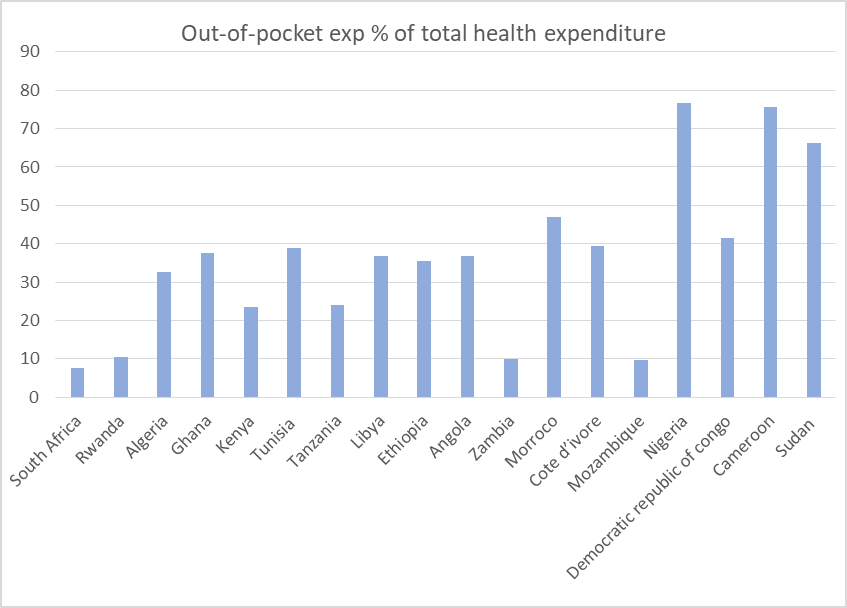
Health care in Nigeria is financed by mostly the out-of-Pocket model. About 69% of Nigerians finance their healthcare needs from personal savings or income. Regardless of their income, they have to pay for any health service rendered to them as well as the cost of drugs. The graph below shows the percentage of total health expenditure financed by out-of-pocket payment in the 18 African countries evaluated by the Future-Proofing initiative. The countries in the graph are placed according to their rank in the financing index. The graph shows that Nigeria has the highest level of out-of-pocket payment amongst the 18 countries. Although the graph does not show a clear relationship between out-of-pocket payment and position in financing, we can observe that the countries with an out-of-pocket rate above 50% are in the lowest rank of financing.
Source: World Bank data, 2018
Out-of-pocket payment is a hindrance to health care given that over 40% of the population live below the country’s poverty line of $0.8 a day (World Bank, 2020). In fact, with the high rate of inflation, an additional 7 million people have been pushed below the poverty line according to a World Bank report in 2021. For instance, the cost of a complete malaria medication is $3 which is approximately 1500 naira. The hospital consultation fee varies between $2 and $50 depending on whether the hospital is private or government-owned. These costs, combined, outstrip the minimum wage of $53 and therefore beyond the reach of many. Government-owned hospitals which is usually the cheaper option would have been the solution to this dilemma but the financial burden is still higher than the estimated poverty indicator. The remaining 60% of the population living above the poverty line are not better off, they still grapple with high medical bills.
Recently, a growing number of the population is being financed by the National Health Insurance. The National Health Insurance Scheme (NHIC) was implemented in 2005 to pool health risks at the national level. The scheme is designed in a way that every member of the society irrespective of economic status would be covered. However, as of 2019, only 5% of the population were enrolled in the scheme. One reason for the low enrolment rate could be because the government has not made it mandatory for individuals in the informal sector. With Nigeria’s huge informal sector (about 70%), one can most certainly say that the scheme is inherently not mandatory. Even within the formal sector, some private employers do not provide basic health insurance coverage for their staff. Another factor that could contribute to the low enrollment rate is unawareness on the part of the populace. Some Nigerians, especially the uneducated populace are unaware of the insurance scheme. Some of those who have heard may not fully understand its implications and advantages over out-of-pocket payment. Hence, they may decide not to enroll in the scheme. In addition, apathy for government-run programs could contribute to the general low coverage in over 10 years.
Though relatively small, another source of healthcare funding in Nigeria is donor finances. These funds come from Non-Governmental Organizations, international organizations, faith-based institutions, and private donors. The donations often come in the form of medical equipment and consumables, drugs, blood banks, vaccines, and funds for hospital construction or renovations. These funds are often targeted at the poor and vulnerable and major disease-burden such as Malaria, HIV, Tuberculosis, Hepatitis, Cancer screening, and eye treatment. In as much as these donor programs have their impacts, they are generally inadequate and not readily available to cover the (infrastructure) financing gap in the health sector.
There is an urgent need for Nigeria to create a pro-poor health financing plan to bring about equity in the country’s health care system. This will entail more government involvement in health financing. The first step could be to optimize budgetary allocation to the health sector. In the Abuja declaration of 2001, African countries were urged to allocate 15% of their budget to the health sector. In the past 2 decades, Nigeria’s average allocation to health care is 4.67%. Eliminating financial barriers to quality and effective health care is another option to be explored. With the high poverty rate, risk pooling methods could be an effective method of eliminating the financial barrier. Insurance and tax-based financing methods are the top risk pooling methods of health financing. Although Nigeria already has the NHIS, more sensitization should be carried out to create awareness and encourage mass enrolment in the scheme. In all, effective health care finance is the first action towards revamping the entire health sector.
Until his usurpation on September 5, 2021, Alpha Condé has been the president of Guinea, a West African nation since 2010. President Condé was a human rights professor and activist who fought nearly four decades for democracy in Guinea before his victory at the polls ten years ago. He became the first democratically elected leader after 52 years of dictatorship in Guinea. President Condé is 83 years old and had completed what should have been his last term in office in 2020 according to the constitution at the time.
Last year, the Guinean parliament held a referendum that amended the constitution and extended the presidential term limit to two terms of six years per term—a slight shift from the previous 5-year term. The referendum was held in March 2020, a few months before the general elections in October of the same year. President Conde sought a leeway in the ‘timely’ constitutional amendment to contest a third term in the election. A media report noted that President Condé had hoped that the new constitution would allow him to restart his presidential tenure. This way, he would be looking at another 12 years in office.
Shortly after the referendum, Condé was re-elected president after winning 59.5% of the total votes at the polls in October 2020. He was subsequently inaugurated for a third term (or by his calculation, the first term under the new laws) in November 2020—despite the allegations of electoral malpractices and violence leveled against him by the main opposition, Cellou Dalein Diallo and other contestants.
Guineans have endured a history of authoritarian regimes since their independence in 1958. Condé was the first publicly elected president. It might be interesting to review the socio-economic conditions in Guinea over the last 10 years.
Socio-economic conditions under Condé
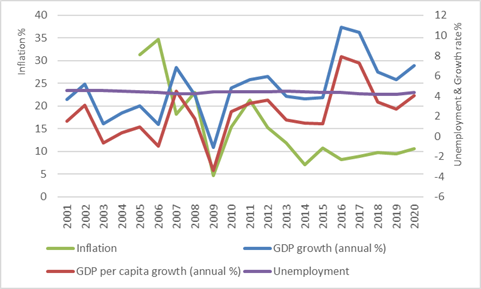
Guinea under Conde has not been as bad (in terms of economic indicators) relative to previous authoritarian regimes. Several economic indicators seem to have improved over the last 10 years—compared to the 10 years before. For instance, Guinea’s gross domestic product (GDP) has been rising following the transition to democracy in 2010. The average growth since Condé’s democracy (2010 – 2020) of 6.2% is higher than that of the previous 10 years under dictatorship – 2.7%. Last year, GDP was $15.68 billion – a 131.1% and 82.4% increase from 2011 and 2016 levels. Figure 1 shows how the growth rate spiked in 2010 and 2016 after Conde’s (re)election in the respective years. Despite the pandemic, GDP recorded a positive growth of 5.2% in 2020. The impressive growth is mostly due to the performance of the extractive sector.
Guinea has significant mineral resource endowments such as bauxite, iron ore, gold, diamonds, and limestone among others. The US Geological Survey data in 2021, reported that Guinea was the second-largest producer of bauxite (82 million tons in 2020) with a proven reserve of 7.4 billion tonnes representing 24.6% of world reserves. According to the African Development Bank’s outlook report 2021, activities in the mining sector grew 18.4% in 2020 from 8% in 2019. World Bank data shows that the rents from minerals have been rising—from 4.45% (2001) to 10.2% of GDP in 2018. Mining accounts for 35% of GDP. China is a major trading partner.
In the labour market, World Bank data shows an average unemployment rate of 4.4% since 2001, lower than the Sub-Saharan (SSA) average of 6.1%. Youth unemployment is however slightly higher at 5.4% (SSA: 11.9%). Agriculture is the main employer of labour accounting for 63.9% of employment. Like other indicators, the price level has fluctuated through the years since 2005; there has been some moderation since 2012 (see figure 1). Last year, inflation was 10.6% (2019: 9.5%).
Figure 1:GDP growth rate and Inflation 2001-2020 | Source: Word Bank data
In summary, Condé’s administration had some positive impact at least on the macroeconomy. It implies that Conde’s democratic regime outperformed the dictatorship regime before him. However, it does not imply that Condé’s regime was the best it could have been. For instance, Guinea remains one of the poorest countries in the world with a per capita GDP of less than US $1000 in 2020. A recent report by the World Food Program showed that 55% of the population live below the poverty line – a sharp increase from 36.1% in 2012. The outbreak of Ebola and Covid-19 worsened living conditions as food insecurity for households was at 21% while 24.4% of infants suffer severe malnutrition. World Bank shows that only about 36% of the population live in urban centres and 50.1% of the urban population live in slums. The exchange rate to the dollar has depreciated 91.3% since Condé took office in 2010. Currently, one US dollar is worth over 9,100 Guinean francs. Guinea is import-dependent as imports of goods and services account for 42.3% of GDP in 2019. Thus, one could argue that economic growth during Condé’s administration was not so inclusive.
In the Human Development Index (HDI) report 2020, Guinea ranked 178 out of 189 – the same rank it had in 2011. Guinea’s HDI of 0.477 in 2019 is below the average of 0.513 for countries in the low human development group and below the average of 0.547 for countries in Sub-Saharan Africa. HDI is a measure for assessing long-term progress in three basic dimensions of human development: a long and healthy life, access to knowledge, and a decent standard of living.
Post-Conde Guinea: Autocracy or democracy?
Since independence from France in 1958, Guinea has been through three dictatorship regimes that ended only after the demise of the dictators. So far, regime changes have been effected through coups. Alpha Condé must have been aware of this pattern and perhaps intended to remain in power for as long.
President Condé, like many African freedom fighters in his time who became dictators, seems to dwell on a certain entitlement (akin to the divine right of Kings) to potentate themselves in power. These autocrats claim to embody a mission only they have the vision to accomplish, clinging unto power, taking out opposition, and suppressing dissent. This entitlement seems to come from the struggles and sacrifices they underwent for the emancipation of the people. The longer they remain in power, the harder it is for them to relinquish it. By altering the constitution to suit his agenda, Condé envisioned at least another 12 years in power, but by raising the budgets of the presidency and parliamentarians at the expense of the civil servants, Condé bit more than he could chew.
Mamady Doumbouya, leader of the palace coup, was a close ally of Condé and the leader of the special forces. Like Condé, he is from the Malinke ethnic group – a fact that diminishes any perspective of ethnic rivalry. Colonel Doumbouya was a legionary in the French Army before returning in 2018 to lead the Special Forces Group in Guinea. Doumbouya was close to government officials as the leader of the special forces; it was, therefore, easy for him to execute a coup. Doumbouya, in his address to the public, claimed a sense of duty to the people was the reason behind the action to halt the authoritarian inclines of President Conde. Even though he restates his commitment to return to civil rule. it is still uncertain how the transition would be conducted. Therefore, the socio-political future of Guineans remains hazy at this point.
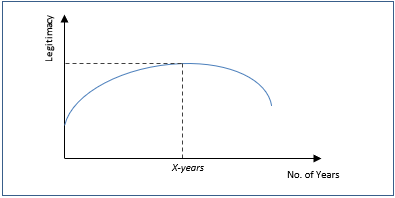
Nonetheless, Doumbouya has not acted differently from putsch leaders throughout history. Typically, putschists intend to change the status quo citing gross misconduct and corruption as the basis for their actions. But a coup is a shock to the political economy and is never an acceptable method of regime change. The international communities intervene by threatening sanctions, demanding a transition to civil rule. But because the putschists are aware of the consequences of their actions – trials or exile – they avoid this by holding onto power, ensuring a semblance of stability, and gradually winning the legitimacy of the people. The longer the putschist seizes authority, the harder it is for him to relinquish it, and the more acceptance or legitimacy he gets as things douse over time (see figure 2). Then he transitions into a democratic rule and the cycle of quasi-democracy continues.
Figure 2: Simple model of putschist legitimacy (Author’s idea)
The question is, how should coups be looked at in the future? Should the international community view palace coups differently? Are palace coups necessary, progressive in the light of prolonged, stubborn dictatorships? Would the outlook be different if a coup is justifiable and the putschists complete a handover process to civil rule? Can coups be justified? What is the implication of such a stance on authoritarian stability elsewhere? What is the situation in the Gambia, Zimbabwe, Libya, and other countries where coups have taken place? What are the alternatives to remove an authoritarian leader who has potentate himself beyond the constitutional limit? Doumbouya seems to enjoy support from Guineans: should the opinions of the citizens matter in such cases?
Coups are supposed to be moribund but seem to be gaining application in recent times. In 2021 alone, Mali and Niger have had attempts at coups; and in Chad, after the death of Idriss Deby Itno, the Chadian Army installed his son, Mahamat Deby as the interim leader. Other recent examples include Sudan (2019), Zimbabwe (2017), and outside Africa, Myanmar in 2021. Coups were common methods of regime changes in many African countries in the years after independence. It has become critical to revisit the implications of coups for regime changes, especially under authoritarian rule.
Access to electricity is still a major challenge in Nigeria despite series of reforms and initiatives since the enactment of the Electric Power Sector Reform (EPSR) Act in 2005. About half of the population does not have regular and reliable access to electricity. Consumers also pay high tariffs despite the absence of significant improvements in the power supply.
The Nigerian electricity sector is unbundled, vertically separating the generation, transmission, and distribution sub-sectors. The generation companies (GENCOs) transmit electricity through the Transmission Company of Nigeria to the (regional) distribution companies (DISCOs) who then dispatch electricity to the end-users – industries, businesses, households. However, the DISCOs have faced problems of financial liquidity and have been unable to provide the basic infrastructure (such as meters and transformers) required for effective service delivery. Yet, the Eligible Customer Scheme (hereafter, EC Scheme) which was introduced in May 2017 would further put pressure on the financial liquidity of the DISCOs and affect electricity consumers through higher tariffs.
The EC Scheme, which is defined in Section 100 of the Act, allows big electricity consumers such as large industries to be supplied electricity directly by the GENCOs, bypassing the DISCOs. The purpose of defining eligible customers is to facilitate competition in the electricity market by allowing customers to purchase electricity from the supplier of their choice, rather than from the DISCOs in their region (regional monopoly). There are four categories of ECs presented by the Nigerian Electricity Regulatory Commission (NERC). The first comprises of those with minimum consumption of 2MWhr/h and connected to a metered 11Kv or 33kV delivery point on the distribution network. The second category covers those connected to a metered 132kV or 330kV delivery point on the transmission network. The third category includes those with consumption higher than 2MWhr/h on monthly basis and directly connected to a metered 33kV delivery point on the network, while the last category is those with monthly consumption in excess of 2MWhr/h and directly connected to the metering facility of a generation company.
While the EC Scheme would enable industrial customers to have access to much-needed electricity and evacuate stranded generated electricity, it has implications for the financial performance of the DISCOs and the electricity tariff faced by non-eligible customers. Large industrial customers account for a substantial proportion of DISCO’s revenue. Thus, the implementation of the scheme would reduce the revenue available to DISCOs, thereby worsening their financial situation and undermining their ability to provide necessary distribution infrastructure. The DISCOs are already challenged by a low tariff environment, high aggregate technical, commercial, and collection (ATC&C) losses and the EC Scheme would further worsen it.
The EC Scheme would lead to an increase in electricity tariffs for non-industrial consumers. The scale of electricity tariff across the various DISCOs shows that the tariff paid by industrial customers (average of N45.72/kWh for Class D2) is over ten times that of residential customers (N4/kWh for R1 – lowest-ranked customers). DISCOs would therefore need to charge non-industrial customers more in order to recover the loss of revenue from industrial customers. In fact, Section 28 of the ESPR Act allows the Commission to impose a competition transition charge on consumers and eligible customers to ensure the affected licensees “earn permitted rates of return on their assets”. The collection of these competition transition charges would constitute an increase in tariffs paid by electricity consumers. Thus, regular customers would bear parts of the cost of the EC Scheme. To mitigate the impacts on non-eligible consumers, the competition transition charges should be limited to only ECs.
Four years since the implementation of the EC scheme, it has been beset by several challenges and controversies, leading to its temporary suspension by the regulator in August 2021. In the notification of the suspension of the scheme, the NERC notified the Transmission Company of Nigeria that several ECs are yet to meet energy consumption requirements and GENCOs do not show proof of excess capacity. In fact, according to the Association of Nigerian Electricity Distributors, the NERC is yet to approve any application for eligible customer status[1].
Although the EC Scheme would enhance competition in the electricity sector in the long term, it works best in a competitive electricity market characterized by efficiency and market-driven tariffs. GENCOs are currently tied to a power purchase agreement with the Nigerian Bulk Electricity Trading Plc, and can only sell additional capacity to eligible customers. With the current tariff structure, GENCOs may be unwilling to invest in additional capacity. More so, the creditworthiness of the eligible customers to sign long-term power purchase contracts with GENCOs is also an issue to be addressed.
At the 2021 African Health Agenda International Conference (AHAIC), the FutureProofing Healthcare Initiative launched the Africa Sustainability index. The index is a data-driven policy tool that aims to measure the healthcare situation of 18 African Countries. These 18 countries were assessed based on 6 vital signs upon which a total score was obtained as well as an overall rank. The 6 vital signs examined are access, financing, health status, innovation, quality, and wider factors. Nigeria ranked 14 out of the 18 countries evaluated, with a total score of 41 over 100. South Africa, Tunisia, Morocco, Algeria, and Ghana were ranked in the top 5 while Nigeria, Cameroon, Angola, Sudan, and the Democratic Republic of Congo ranked in the bottom 5. All 18 countries were also ranked based on their performances in the respective vital signs. Nigeria’s best ranking was 6th under the Innovation vital sign, while the worst ranking was 17th under the vital sign Health quality. The general performance in the innovation vital sign was however poor as Nigeria ranked 6th with a score of 38.
Nigeria’s performance in the Sustainability index is not impressive and begs to question whether growth measures in Nigeria are merely quantitative. To put things in perspective, Nigeria has a GDP of USD 400 billion, the largest in Africa, but ranked among the least performers. Meanwhile, South Africa, Algeria, Morocco, and Ghana that ranked in the top 5 on the index are among the top 10 GDP in Africa, suggesting some correlation between GDP and performance in the African Sustainability index (or better still, healthcare infrastructure). However, Nigeria’s performance defies this intuition. How does a nation with such economic strength perform abysmally in a health index?
Many factors explain the distortion from GDP to poor healthcare delivery as captured in the health index. For instance, low health sector spending to GDP of less than 4% (global average is 8.8%); low budgetary allocation to the health sector to increase the supply of critical infrastructure or low health workers per capita amongst others are some of the challenges in the health sector. In the Abuja Declaration of 2001, heads of state of the African Union countries pledged to allocate 15% of their annual budget provisions to improve the health sector. According to a report by dRPC, in those 20 years, Nigeria allocated only 4.7%, on average, to the health sector – the highest allocation of 6.08% was in 2012. In 2020, allocation to the Ministry of health was 4.05% (from 3.83% in 2019) – a marginal increase despite the pandemic. Only Rwanda and South Africa have the 15% benchmark as of 2011; Nigeria is apparently off track at 4.52% in 2021.
The role of institutional factors constraining health sector performance can not be overlooked. Some institutional factors that stymie health sector performance directly and indirectly include:
Weak Institutions: Over the years Nigeria has set up various institutions and reforms in the health care sector. For example, in 2004 the National Health Insurance Scheme (NHIS) was established to tackle the challenges to healthcare access and financing at the household level. Nigeria’s performance on the Financing vital sign implies that the NHIS has not been very effective. For instance, the NHIS is largely not mandatory; and that weakens its effectiveness especially in the informal sector. Consequently, insurance coverage in Nigeria is still at less than 5%. In 2018 76.6% of current health expenditure in Nigeria is still out-of-pocket. A robust scheme and implementation framework are necessary to ensure the effectiveness of institutions, policies, and reforms to achieve a far-reaching impact on society.
Political instability: Insecurity, terrorism, and violence create an unsafe and tense environment for all sectors in an economy including health. Nigeria has an average score of -1.8 on the Political Stability index calculated from 1996 to 2019. The political Stability index range from -2.5(weak) to 2.5(strong). For comparison, South Africa and Tunisia have an average value of -0.15 and -0.27 respectively for that same period. With civil and political unrest, health infrastructures are destroyed. Qualified health care personnel are often discouraged or scared of providing services in conflict-prone areas. This creates a wide disparity in access to healthcare. Often, the international community intervenes with voluntary workers such as the Doctors without borders and Red Cross.
Corruption: Transparency International defines corruption as the abuse of entrusted power for private gain. This means the misappropriation of funds and resources meant for a particular public good. Nigeria ranked 149/180 in the corruption perception index with a score of 25/100. For Comparison, South Africa and Tunisia both ranked 69/180 with a score of 44, while Cameroon and Angola ranked 15th and 16th in the African Sustainability index ranked 149/180 and 142/180 respectively in the corruption perception index. The NHIS is a regulator and an operator which is in contravention to the Act stipulating that it should function as a regulator with defined roles. Also, poor supervisory activities create leeway for the hospitals and Health Maintenance Organisations (HMOs) to exploit subscribers who, in most cases, have limited information about the workings of the system.
What does this situation mean for our race to Universal Health Coverage (UHC) by the year 2030? According to the World Health Organization (WHO), Universal Health Coverage is a situation where all individuals and communities receive the necessary healthcare and treatment at a rate affordable to them so they do not undergo financial hardship. This means that for a nation to achieve UHC, they have to ensure that quality healthcare is available to all individuals irrespective of economic class. This concept was mooted by the world health assembly in 2005 and adopted as the 8th target of the Sustainable Development Goals (SDG) goal 3.
The Sustainability Index provides a clear insight into Nigeria’s lapses, calling for urgent policy and action-driven responses. The six vital signs examined in the index exposes thematic policy areas that enable Nigeria to achieve UHC by 2030. This article is the first in a 3-paper series to address some thematic areas of healthcare based on the 6 vital signs captured in the index. For this purpose, the 6 vital signs will be grouped into two thematic areas namely, Healthcare Financing and Healthcare delivery/access. The subsequent series will examine broadly, the two groups.
The previous year 2020 was unusual. The Coronavirus pandemic was a major headwind, and its effect would linger in many developing countries like Nigeria. Governments are not certain to see significant improvement throughout the year 2021 despite the intervention programs. In Nigeria, the EndSARS campaign in the last quarter of 2020 caused a gaping fissure to the foundations of national politics. As a result, varying levels of tensions have been experienced through 2021. Open incidences of robbery, kidnapping, terrorism, political and ethnic suspicion are a few.
Politics affect economics. Over the last 15 years, security crises in the Southsouth and Northeast have thwarted growth and prosperity in Nigeria. As the polity quakes, businesses struggle. The declining output and rising unemployment combine to limit the alternatives available to households even as inflation erodes the value of their savings. The political economy is unstable. Therefore, it is important to analyze the outlook for the rest of the year and examine the implications for businesses and investors looking to make decisions.
In Nigeria, the solid mineral sector is experiencing a revisit and therefore, increasing government and private sector attention following the herald of economic diversification and industry reforms since 2016. The 2018 State Disaggregated Mining and Quarrying report published by the Nigeria Bureau of Statistics counted 43 different solid minerals across the states of the federation. Despite stagnating nominal growth rate in the mining sector, the mining sector real contribution to GDP has been improving.
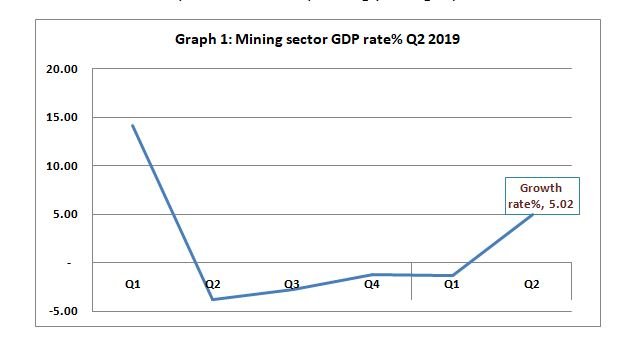
Recent data from the Nigerian Bureau of Statistics (NBS) Nigeria’s Gross Domestic Product (GDP) grew by 1.94% in Q2 2019. The Mining and quarrying sector contribution to GDP was 8.84 percent, a decline of 11.47 percent from Q1 2019 and 28.3 percent in corresponding year-ago quarter.
The real sector grew by 5.02% (year-on-year) during the second quarter of 2019. This was 8.85% points higher compared to the same quarter of 2018 and 6.38% points higher than the first quarter of 2019. On a quarter on quarter basis, the growth rate recorded was –0.72%. The contribution of Mining and Quarrying to Real GDP stood at 8.97%, slightly higher than 8.71% recorded in the corresponding quarter of 2018 but lower than 9.29% recorded in the first quarter of 2019.
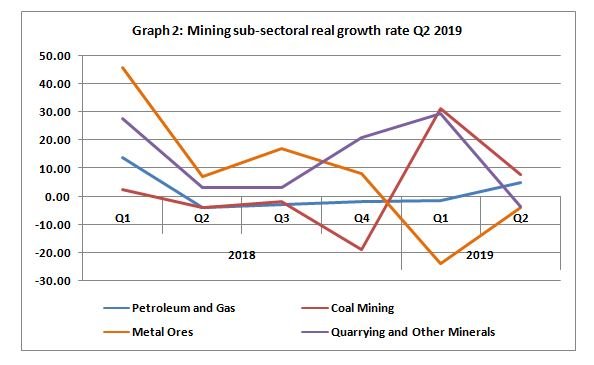
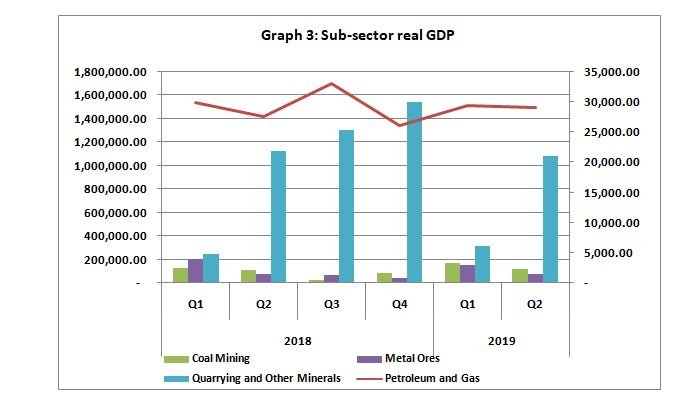
The chats in graph 3 show that crude petroleum and natural gas accounts for the most fractions in the Mining sector GDP, followed by quarrying. The representation in graph 3 shows the trend in the subsectors: the production of crude petroleum and natural rises and falls in the same pattern as quarrying, even though latter rises and falls faster. The trend also reveals some seasonality in quarrying as it falls sharply in Q1 and picks up in Q2. More so, there has been a significant uptick in the activities around metal ores and coal mining since the solid mineral roadmap in 2012 and 2016 – notwithstanding the seasonal deep in coal mining every Q3 and Q4 for metal ores activities since 2015.
Snapshot of solid minerals output by regions
The total output of solid minerals in Nigeria across states and regions in 2018 stood at 55.8 million tons compared to 45.8 million tons in 2017 and 43.44 million tons in 2016. South-west followed by North-central tops the list with a total output of 20 million ton 18.21 million respectively – accounting for 35.82 percent and 32.62 percent respectively.
The data from NBS show that Limestone alone accounted for 48.7 percent of the total production of solid minerals in 2018. Granite (17.24 percent), Laterite (9.08 percent) and Clay (7.21 percent) are among the largest solid mineral production. The laggards include Topaz, Ruby and Garnez.
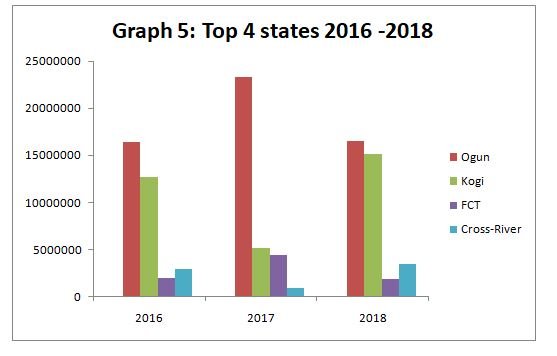
Ogun state, South-west Nigeria retains the largest solid mineral output across the country. It is the major bolster in the region in terms of solid mineral production. Ogun state accounts for 29.53 percent of the total output in 2018—a 41.95 percent decrease from 2017. In 2017, the state claimed 50.89 percent of total national output. The graphics below shows a declining output since 2017.
Kogi state is another top performer in terms of solid mineral production. Like Ogun in the South-west, it is the major anchor in the North-central. It recorded significant output growth between 2017 and 2018. It recorded an output growth of 189.45 percent between 2017 and 2018 contributing 27.1 percent of total national output in 2018. Other top performers include Cross-River and FCT with 6.25 percent and 3.4 percent respectively.
Plateau state – North-central – has the most varieties of mineral deposit with a count of 19 different solid mineral endowments. It, however, accounts for only 0.16 percent of national output. Nasarawa, another state in the North-central takes the second position in the count of mineral deposits with a total count of 13 different solid minerals. It suggests that the vast land in the region is richly endowed with a variety of mineral resources.
The South-east is the least in terms of output with a total production of 2 million tons representing 3.69 percent of the total national production. Whereas Ebonyi state is the lead performer in the region with significant production in granite and lead, Imo is the least performer with recorded production in Sand dredging alone.
The least performers across region include Borno (8403.30 tons), Rivers (19548.68 tons) and Yobe (41,591.49 tons). It is not clear whether the limitation in production in Borno and Yobe is due to insurgency in the region or the quantum of minerals available, but the overdependence in crude-oil exploration crowd-out interest in other sectors.
Remarks
In conclusion, there is room for progressive investments across regions dwelling on the mineral demographics. The positive trend in real GDP connotes positive efforts and feedback in the sector.However, the production output in Limestone, Granite and Clay suggests that explorations are lopsided towards cement and construction materials. It may be necessary to look into other diverse mineral endowments of economic importance; rely on the private sector participation and other stakeholders to expand the base of production.
2006/7 was when I first read Nigeria off the pages of a foreign textbook on development. I had little training on the matter, so it meant so much to me just reading that we were the ninth most populous country in world! I thought it meant recognition; you know, strength. We had just been head-counted to a high of about 142 million people. In another six years, an addition of over 27 million occurred, moving Nigeria up to the seventh most populous nation in the world. Today, forecasts predict over 300 million people by 2050, which will surpass the United States at the third position, after China and India. For now, it corridors around 191 million people.
According to the World Population Prospects report (2017), of the nine countries expected to contribute half of the world’s population from 2017 to 2050, Nigeria comes second after India and has the worst real GDP growth rate. Ethiopia is the second most populous in Africa at 101 million people over a total land area of 1,104,300 sq.km; relative to Nigeria, it implies an excess of 477 people per sq. km. Algeria and Congo DR are the largest countries in Africa with distinct land masses twice the size of Nigeria, but with populations 4 and 2 times less than Nigeria’s, respectively. They have, respectively, real GDP growth rates of 1.4 and 2.8 per cent, whereas we are barely recovering from the negative growth rate of 0.8 per cent. Algeria’s population today is over 5 million people less than Nigeria’s in 1960! We are increasingly losing the ability to feed even half of our population.
The population growth is due to a combination of factors, mainly: high fertility rate (5.13 births/woman), improved life expectancy (54.3 years) and decline in death rates. A look at the Nigerian population live clock delivered by Worldometer’s RTS algorithm presents a clear image of births every second. Uncontrolled population is a real problem in the context of one Earth. The Extremist argument attributes all the world’s economic and social evils – poverty, hunger, environmental degradation – to population explosion. Empirical research reveals that it instigates economic growth slowdown, poverty, food crisis, poor health conditions, increases in legal and illegal migration and environmental challenges. The world’s population of 7.6 billion, with a projection of over 9.8 billion by 2050, calls for global concerns, especially in Africa, from where most of the increase would come. Nigeria represents 2.5 per cent of the world’s population; by argument, therefore, it contributes the same amount of global sustainability issues due to population explosion. No wonder there is competition for everything- from medical to security services, to transportation, schools and jobs.
Yet it is for us no scare that there is not an official population policy document, let alone an active one. China, India, Bangladesh, South Korea, and Singapore have adopted different programs: from official policy disincentives for large family size to more severe programs of sterilisation as measures to curtail population pressures. In Nigeria, the checks against population explosion are the unnatural–high mortality rate, terrorism and epidemic. July 11, 2017, was World Population Day, and it was marked by the usual lip service of bandying around family planning buzzwords and speaking to figures and statistics. A classic case of all talk, no action. Senator Ben Murray-Bruce aptly captures the folly in thinking our population is an asset instead of the liability that it is. A concerted government effort on population is inevitable for a country like Nigeria, where half of the population exists below the poverty threshold. As Todaro and Smith (2006) put it, “it is not numbers per se or parental irrationality that is at the root of the LDC ‘population problem’. Rather, it is the pervasiveness of absolute poverty and low levels of living that provides the economic rationale for large families and burgeoning populations. And it is the spillover effects or negative social externalities of these private parental decisions […] that provide the strictly economic justification (in terms of ‘market failure’ argument) for government intervention in population matters”. These family planning advocacies alone are ineffective. A more stringent measure is long due.
Given our cultural and religious orientation, the sterilisation policy for married couples, even though efficacious, may meet widespread criticisms. Hence, a combination of policy alternatives such as economic incentives and disincentives for large family size, legislation to improve the social and economic status of women, alongside established family-planning programs, would get better reception. A more stringent policy would be to legislate on the minimum age of marriage for women to 30 years and a maximum of two children. Children born outside of this legal condition would attract medical bills (at market rate) borne by the parents and may not be considered for some social benefits, even though they would be citizens. Such children would be the direct responsibility of their parents. This would effectively moderate the fecundity of the population, attacking the problem from its roots, and extend the timeline of personal development for the girl-child. A rigorous effort against child marriages and girl-child education should be promoted across the country. Cash transfers and a coupon system could be inaugurated to benefit only small family sizes. However, an established social security and citizen database is a prerequisite for this to work. Again, the official employment benefits for workers and civil servants, such as family health insurance and accommodation, should be reduced to cover a maximum family size of four (down from six).
Overall, these issues should not be subordinate to cultural beliefs and religious interpretations. Unchecked population has degenerating consequences for sustainable living. The traditional monarchs and grassroots leaders should be involved in promoting this agenda. Combating population issues should be included in the development agenda. Another implication of this is the subtle repeat of history: African labour built Europe and America in the slave era, and African youths are already beginning to sustain their economy in light of their ageing population through migration.
The stock market is a mechanism that enables risk sharing and wealth accumulation. No wonder it continues to surprise and interest financial experts that most individuals do not invest part of their wealth in the stock market – a phenomenon dubbed non-participation puzzle. While financial illiteracy may explain some non-participation, it is common to find financially literate people that do not participate in the stock market.
Background risks, which are undiversifiable risks such as human capital risk, labor-income risk, and health risk, generally explain why many individuals do not invest in risky financial assets. The idea is that when individuals face such independent risks, they are less willing to expose themselves to risky assets. Indeed, background risks are notoriously high in the Nigerian socio-economic environment, due to high economic uncertainty and zero social safety net. However, that individuals in Nigeria still take other avoidable risks, e.g., willingness to build start-ups and migrate to new environments to start life afresh, suggests that background risks are not the whole story.
Other common reasons why literate individuals shun the stock market are “it’s too risky”, “it’s simply gambling”, and “I don’t have time for it”. For most people, particularly the young, these reasons are simply nonsensical; they stem from misunderstanding. Let’s begin with “it’s too risky”. Financial research tells us that no amount of risk aversion can justify non-participation in the stock market. If you are more risk-averse, it would only necessitate reducing the share of risky assets in your portfolio, not non-participation. Moreover, higher risk generally means higher reward, and there are simple ways to reduce the risk of financial investments such as diversification.
The gambling claim depends on one’s investment horizon. A short-term investor looking for quick gain may be justified to see the stock market as a casino. This article is not for such individuals. For the long horizon investor, the stock market is not a gambling scheme. The expected return, i.e., the anticipated gain on investment, from the stock market is generally positive. This is not the same for casino gambles or “Betnaija”, which have high probability of losses and small probability of big wins that often generate negative expected value.
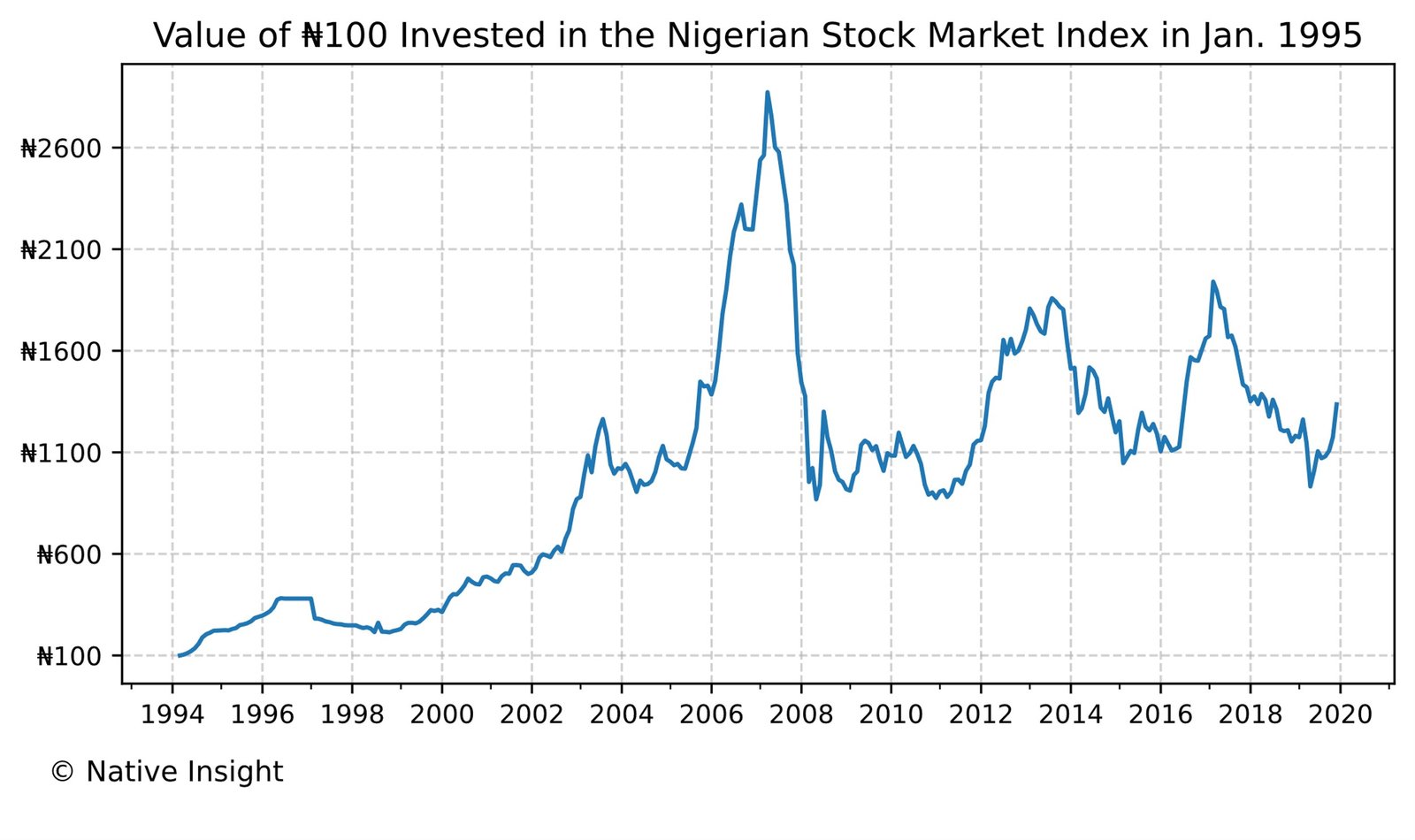
To drive home the point, Figure 1 shows the value, over time, of ₦100 invested in January 1995 in a portfolio that tracks the Nigerian All-Share Index. Despite the huge volatility in the value over time, by October 2020 the ₦100 would have risen by more than ten times to ₦1,400. Compare this to depositing the ₦100 in a savings account, which is what most people mindlessly do, at a “generous” yearly interest rate of 3% p.a. By October 2020 the money would be worth only roughly ₦210, and the investor would have lost the opportunity to make an additional “risky” ₦1,190 through the stock market. No wonder Robert G. Allen aptly asked, “How many millionaires do you know who have become wealthy by investing in savings accounts?”
Therefore, that the stock market is risky does not make it a gambling scheme, since over the long run you are sure of reaping positive returns from your investment. The stock market does not reward investors for nothing. The returns are compensation for sharing in the risk of businesses, as well as for transferring liquidity to yesterday’s investors that need to cash-out and consume today. This crucial activity enhances the economic growth and collective welfare of societies.
Figure 1: The value of N100 investment from 1995 through 2020
The claim of some individuals that they lack the time to follow individual stocks and make an informed investment is indefensible because financial practitioners have designed products, such as passive mutual funds, active mutual funds, and exchange traded products, that solve precisely this problem. Furthermore, basic investment wisdom advises that if you do not have superior information to guide selective investment in specific stocks, then it is optimal to invest in a well-diversified portfolio that represents the market. Such passive portfolios, packaged as “passive mutual funds” or “Index-based exchange traded funds”, have long existed in the Nigerian stock market. You need not do more than open a brokerage account to buy such funds and easily replicate the performance in Figure 1. For individuals that believe in doing better than the market with selective-investing, “active mutual funds” aim to achieve that. However, active funds cost more and fail to consistently beat the market after fees and expenses.
Common Pitfalls in Stock Investing
With the assumption that false doubts have been cleared and Figure 1 is encouraging enough, let’s turn to common mistakes individuals should avoid when investing in the stock market. The first is under-diversification due to familiarity bias. Examples include buying mostly the shares of the company you work for or the shares of companies in the same industry as yours. This common practice is wrong because your investments would end up losing value when you are least equipped to cope with the loss. Examples are when your industry and employer are facing severe financial turmoil and you face a high risk of losing your job. A better strategy is to invest in a broad portfolio that includes several industries, companies, and, as is now possible in Nigeria, international stocks. That way, one stock’s loss can be offset by another’s gain, hence reducing risk and in some cases not hampering return. As the Nobel Prize-winning economist, Harry Markowitz, famously stated, “diversification is the only free lunch in finance” – don’t miss it.
Next, avoid too much trading. Trading involves transaction costs, which add up to sizeable sums. Research shows that individuals that trade a lot underperform the market after accounting for transaction costs. Moreover, given that you are encouraged to invest in diversified portfolios for the long term, there is scarcely any justification for frequent trading. The final mistake to avoid is disposition-effect – the tendency to sell stocks that have gained in value while holding unto losing stocks. This is wrong for several reasons. For instance, it increases the present value of capital-gains tax obligations and defers the realization of offsetting tax benefits from capital losses. Moreover, since momentum – the tendency of stocks that have gained in value to keep gaining and vice versa – is commonplace in the stock market, disposition effect likely sacrifices further gains and accommodates further losses.
Recent research evidence shows that the rich keep getting rich due to high returns on their capital through investment in risky assets like stocks. Returns on capital far exceed returns on labor, which is a strong reason why one should put her money to work by investing in the financial market. When only the rich invest in stocks, inequality spreads and the poor miss out on opportunities to climb up the social ladder. Investing has become very cheap and easy. You can do it all with your mobile phone at little or no cost. Why not start building your financial fortune today!