I refer to ‘Boyonomics’ as the ideas of Henry Boyo, a Nigerian who has persistently contested the monetary framework of the Central Bank of Nigeria (CBN) since the turn of the millennium. Boyo’s ideas build on the condition in the foreign exchange market where the CBN is the single monopolist. The CBN captures the dollar revenues of the state, converts at a unilateral rate against the Naira, before disbursing to the arms of governments, MDAs and Bureau de Change (BDC). This is equivalent to minting of naira notes (naira flood). Because the dollar revenue which has been captured by the CBN via its monopoly stance creates dollar scarcity, there is a constant devaluation pressure against the naira relative to the dollar. So to ease the pressure on the naira following the naira flood, the CBN intervenes – in the money market – with a ‘mop-stick’ by exchanging promises-to-repay in order to clean up some naira liquidity. This monotonous routine has been the operational framework of the CBN that Boyo vehemently criticizes. He has endured cursory attention – if not outright disregard – by the relevant authorities. He proposed a system that issues dollar certificate to the statutory beneficiaries with which they would offer to buy Naira in the open market such that it would be dollars chasing naira – the currency in demand gains value. But does it translate to value for the naira?
Weaknesses in the Logic
‘Boyonomics’ may not translate to increased value for the naira, rather to correct valuation of the naira at higher exchange rate! For clarity, take the currency as a tradable good paid for with goods/services. Offering a currency in the open market – to compete – implies that it has some values driving its demand. The naira is mostly backed (indirectly) by the extractive industry which is the major foreign exchange earner, but the sector is also the base of the global production value chain; and since naira is not the currency in trade, the value derives from the foreign reserves. It becomes glaring that the naira, beyond the territorial bound in which it is a legal tender, is not as worthy as the digits inscribed on it. This implies that the statutory beneficiaries, who bear these dollar warrants, negotiating from a position of strength, would demand more naira for each dollar under the liberal framework, and the banks, tempted to increase their stock of valuable dollars, would comply! Hence, under the liberalized foreign exchange market, the correct naira valuation would go under at the mercy of the dollars; and the economic woes of devaluation – eroded purchasing power, deplete foreign reserves and stagflation – would lead to suicides and revolution.
Again, assuming the representatives of the statutory beneficiaries are sincere, they would recognise that the critical short supply of infrastructures requires dollar expenditure to close: they would therefore develop preference for higher dollar balances. This implies that only the dollar sum enough to meet the naira denominated recurrent expenditures would be offered in the foreign exchange market. On the private sector side, major exports are extractive based, industries require foreign input – implying that we depend largely on imports for processed goods. All these, denominated by our population make up huge dollar import bills which take tolls on the naira value.
Why the CBN may not float
DollarDebts: generally, developing countries are not able to borrow in their domestic currencies; and infrastructural gaps imply that they require huge dollar borrowings to buy foreign technologies to minimize gaps. These liabilities are denominated in foreign currencies whereas assets are denominated in naira. In the event of shocks, a depreciation in local currency could have a devastating balance sheet effect that dwarfs the assets side (in naira) relative to the liability side (in dollars), crippling the entire financial system. Also, it becomes even more expensive in terms of naira to repay foreign debts.
Credibilityof the CBN: ensuring price stability is a statutory responsibility of the CBN. A credible central banker would want to stick to announcements about inflation targets. Therefore, the CBN, in a given period, sets a target on inflation under a loss minimization program. But because economic agents are rational, they would form expectations and engage in contracts which make the initial policy announcements of the monetary institution sub-optimal. Therefore, the central authority, in order to increase welfare (employment) along the Philips curve, deviates from announcement, creating surprise inflation. The implication here is that sustained inflation may not be the result of irrational policy decision of the central bankers but reflects their inability to commit to policy announcement due to the rational expectations of private agents. This means that the exchange rate volatility in a float system has a pass-through effect on inflation and interest rates which challenges the credibility of the CBN to stick to rules on inflation target.
Dollarization: floating the exchange rate would lead to massive devaluation of the domestic currency as we saw in the last attempt by the CBN to liberalize the market in 2016/2017. Foreign goods would become more expensive, inflation bolts in: as the naira loses value, importers would develop preference for (increasingly) scarce dollars so as to reduce the transaction costs of exchanging currencies. This would weaken even more the naira fiat, making way for the dollar as the currency in trade, superior to the naira. If this is the case, it weakens the ability of the CBN to use monetary instruments. There is the argument about the counterbalancing effect of devaluation which increases exports revenues via the price and quantity effect such that devaluation means well if the Marshall-Lerner condition holds. But are we a net exporter by balance of trade?
In conclusion, initial devaluation and uncertainty in real exchange rate bear significant output costs via reduction in investments. However, the essence of this argument is not to discredit the efforts and ideas of the man in almost twenty years, but rather to glorify his persistence with an objective response based on the principles of economics. It is possible for the CBN to run simulations based on the idea, followed by a trial depending on the results of the simulation. He deserves recognition, if not an award.
For a developing country, debt accumulation is inevitable for national governments. Government spending is typically financed by government borrowing – externally and domestically – and by raising taxes. However, it is equally vital to have a sustainable debt management framework so as to avoid over-borrowing. National and sub-national governments must incorporate some kind of inter-temporal framework in their borrowing strategy such that consumption today does not mean liability for tomorrow’s generation.
In Nigeria, the Debt Management Office is the institution saddled with the responsibility of managing the nation’s sovereign debts. Periodically, it conducts stress tests to ascertain the sustainability of the debt stock against the prevailing macroeconomic environment and the scenarios in the domestic (debt) market.
The last Debt Sustainability Analysis conducted in 2017 by the DMO adopted the latest version of the joint World Bank/IMF Debt Sustainability Framework for Low-Income Countries which provides indicative debt thresholds that reflect the quality of a country’s policies and institutions. It is based on the World Bank/IMF’s Country Policy and Institutional Assessment (CPIA) index ranking which classifies countries into one of the three policy performance categories: Weak Policy (CPIA<3.25); Medium Policy (3.25≤CPIA≤3.75) and Strong Policy (CPIA >3.75), and applies different indicative debt thresholds, depending on the performance category. Along with such countries as Ghana, Mozambique, Ethiopia and Sierra Leone, Nigeria is classified as a medium performer on the CPIA index with a score of 3.41.
The 2017 DSA included a stress test for the economy under three scenarios: the baseline scenario which hinges on assumptions of the annual budget and the medium-term expenditure framework (MTEF) 2018-2020; the optimistic scenario anchors on the optimism of the Economic Recovery and Growth Plan (ERGP) with a target growth rate of 4.80% in 2018 and 7% by 2020; while the pessimistic scenario assumes continued shock to the foreign exchange earner – crude oil – at less than $30pbd, deterioration in the external balance and depreciation of the domestic currency.
Total Public debt stock (H1 2019)
National debt
2018
2019
Diffrence
%change
Total Public debt (USD ‘bn)
73.2
83.9
*10.7
14.62
External Debt (USD ‘bn)
22.08
27.16
5.08
23.01
Domestic Debt (NGN ‘trn)
12.15
17.38
5.23
43.01
Domestic Debt (USD ‘bn)*
51.12
57.74
5.62
10.99
Table 1 Nation debt 2018 – 19
However, since the GDP growth rate has hovered below 2 per cent behind the ERGP optimism of 4.80%, but global oil price has hovered around USD60pb, and the naira exchange rates have been stable at N359/USD1; it may be objective to evaluate based on the baseline scenario since the scenarios in the other extremes have not been experienced.
As of June 30 2019, the Debt Management Office (DMO) reported that the debt stock (both national and sub-national) stood at N25.7 trillion (USD83.9 billion)—this represents a 14.6 per cent increase from the preceding year. Of this total, domestic debt accounts for 67.6 per cent (= N17.38 trillion), while external debt standing at N8.32 trillion (USD27.16 billion) accounted for 32.38 per cent.
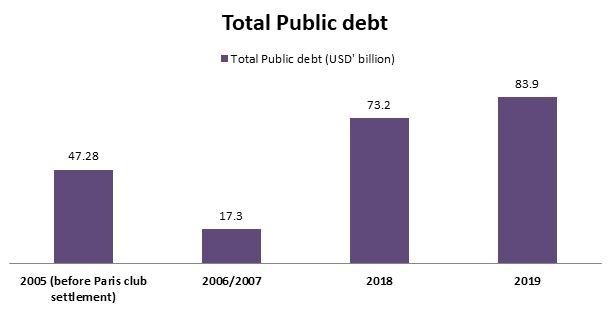
In 2018, the Debt Management Office (DMO) proposed an extension of the borrowing threshold from 19.39 per cent to 25 per cent. However, with the addition of N10.7 trillion in 2019, Nigeria already surpassed the 25 per cent threshold (see Table 1). Figure 1 shows that since-after the Paris club debt write off, the nation’s public debt stock has risen by over USD65 billion – more than twice the debt written off. The DMO also adopted a strategy to increase the ratio of domestic to foreign debt as a cushion to external (foreign currency) shocks. Table 1 shows, however, that the rate of change of domestic debt is lower (11 per cent) in terms of the foreign currency than in domestic currency (N43.1 per cent). This would be due to the exchange rate effect. Should the DMO revise or revisit its debt strategy?
Figure 1 Total Public debt as of June 2019
Sinking Funds
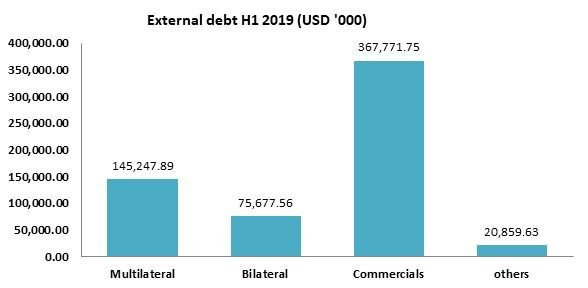
In the first half of 2019, the total amount of external debt servicing and interest payment on domestic instruments amounted USD 609.56 million and NGN800.11 billion respectively. These values are 2.2 per cent and 4.6 per cent of their corresponding total. Commercial papers and Eurobonds took 62.2 per cent of the total debt service funds while bilateral debts got the least – 3.4 per cent in Q2 2019.
Table 2 External debt H1 2019
For domestic debts servicing, FGN bonds claimed more than half of the total interest repayment in the first half of 2019; whereas FGN savings bond had the least with NGN658.54 million. From the table, most of the repayments were done in the first quarter of 2019 valued at NGN610.3 billion – representing 76.3 per cent of the total. And the FGN bond took NGN 480.85 billion.
Table 3 External Debt H1 2019 (USD’ 000)
External Debt H1 2019
Debt servicing
Q1 2019
Q2 2019
Q1 % of total
Q2 %of total
H1 2019
Multilateral
79,397.93
65,849.96
22.23%
26.10%
145,247.89
Bilateral
67,099.39
8,578.17
18.78%
3.40%
75,677.56
Commercial/E-bond
210,759.58
157,012.17
58.99%
62.23%
367,771.75
others
20,859.63
8.27%
20,859.63
Total
357,256.90
252,299.93
100%
100%
609,556.83
Table 4 Domestic Debt H1 2019
Int. on instruments
Q1 N’bn
Q2 N’bn
H1 N’bn
NTBs
120.92
45.71
166.63
Treasury Bonds
6.25
6.25
FGN Bonds
480.85
128.99
609.84
FGN Savings Bonds (N’Mn)
347.92
310.62
658.54
FGN SUKUK
8.17
7.85
16.02
FGN Green Bond (N’Mn)
718.53
718.53
Total
610.28
189.83
800.11
Conclusion
The year 2019 has been an interesting time. Macroeconomic indicators are not impressive: inflation is above 11 per cent, GDP growth less than 2 per cent, unemployment is high above 25 per cent and debt and debt servicing continues to hover over the bars. Increased government presence in the debt market would crowd-out private sector investments and matters would be debilitating. Recently, the Central Bank of Nigeria restricted the purchase of its OMO bills to banking institutions and Foreign Portfolio Investors (FPI) in a bid to re-channel funds away from risk-free assets to real sector investments. This is expected to moderate yield environment and reallocated resources to growth sectors. However, monetary institutions have to be strategic going into the New Year to hedge against external shocks and other fundamental uncertainties.
Not all statistics are worth losing sleep over. Some are just for the informational content. The home-ownership rate is one such: it is a measure of the proportion of people who live in their own houses. It indicates the strength of mortgage market and at best, a measure of aggregate prosperity. When it is low, it implies that something has to be done to increase prosperity – not home-ownership per se – in the expectation that prosperity would bring the wealth and motives to acquire homes. However, at some point in our development path, we took the wrong approach towards increasing the level of home-ownership. The government, instead of investing in housing, conducted ‘fire sales’ of public lands to the highest bidders, increasing the relative scarcity of land and its prices. Soon, everyone wanted to own lands, it had become popular as the ‘best investment’ irrespective of its high capital-output ratio. Private individuals flooded the housing market. The government eventually exited the market as it became difficult to regulate.
Today, the effects of this unstructured deregulation include illegal sales, land grabbing, collapse of urban planning, rise in squatter settlements, unhealthy competition for lands, uncontrolled factor pricing, cost-push inflation, and rising housing deficit. These made other public infrastructure – water, sewage system, and transportation – necessary for urban planning almost impossible to develop. This approach to increase the rate of home-ownership does not reduce the rate of homelessness, rather increases it.
There is a housing deficit of about 17 million. It would take the production of one million units per annum over a 20 year period to close this gap. But overall annual fulfilment is 100,000 units and a corresponding deficit of 900,000 units which carries a potential cost of US$ 16 million. The mortgage market is somewhat labyrinthine with 57 players, but mortgage financing to GDP is 0.58% (South Africa, 31%), home-ownership is 24% (Kenya, 73%). Mortgage conditions are stringent: interest rates are as high as 20% and a 25% down payment on an average mortgage size of US$ 18,000 – in country where 87 million people live below US$ 1/day. The focus should be eradicating extreme poverty not increasing home-ownership.
Presented with evidence of market failure, the visible hand of government is necessary to restore equitable distribution and social optimum in the housing market. But governments too have failed.
A number of state governments have attempted mass housing schemes: it is typically a few blocks of bungalow houses built in remote locations, deserted and often unliveable to those for whom they were intended. And when these governments realize their failures, they enter into a quasi-partnership with government compradors who connive with other individuals, in the guise of estate developers, to off-take the lands being sold out by government ministries and local communities under shady negotiations – with no pretension to transparent market process. These pseudo-developers go on to build luxury houses for themselves and the upper class. No consideration for the vast poorly-housed lower class. Ogun state is a classic case: the government and communities are off-loading the lands to churches, private developers and foreign businesses in a fate of competition with Lagos state, ignorant of the current challenges Lagos state faces. They are losing the opportunity as a sparsely populated state to initiate integrated city development.
So while these estate developers continue to build for the top 1 per cent that could afford home-ownership and already own estates, nobody builds for the ordinary man. A subtle paradox ensues: a simultaneous development of luxury estates and slum estates; whereas the former is largely unoccupied, the latter is overcrowded. The results of markets is not always optimal: no wonder while there are slum cities to revamp, scarce resources were rather directed towards building a new luxurious Eko-Atlantic city despite the number of unoccupied apartments in Ikoyi, Victoria Island and the environs. It was only recently that we realized that these empty buildings served other purposes as cash vaults to hide away stolen monies. This partly explains why rental prices are downwardly rigid in these environs where there is a glut of albeit, luxury homes.
Housing, like education and health is a critical sector in which the government cannot laissez-faire. The high capital-output ratio in housing investments implies that unchecked markets would not yield socially optimum outcome. The visible hand of government is necessary both as a player and regulator to steer the market to desirable outcome. Housing is a major part of household consumption and savings motives in developing countries. Therefore, improving housing conditions would have positive implications for standard of living.
Concluding remarks
Sadly the housing production model continues to be about luxury homes even though it is not working! The diaspora city plan of the Federal Housing Authority to build estates for Nigerians living outside of Nigeria is a case of government betrayal of the majority of Nigerians living in Nigeria with no decent roof over their heads. Government needs to return to the market: they need to increase the percentage of total land stock in the government’s possession even if it means revoking certain land titles. They need to provide proper incentives to local authorities, housing associations, private establishments and community organizations that have the resources and can endure the long-term risk-return nature of housing investments to produce standard rental units at affordable prices. Housing units could be built and then sold apartment by apartment in which case the overall assets still remains in public ownership, allowing therefore for integrated maintenance and urban planning. This was the Jakande model in 1983 Lagos state. These sorts of collaboration and coordination are necessary to correct the market distortions and provide affordable homes for Nigerians. However, the rhetoric needs to be changed: everybody cannot be homeowners. Therefore, there should be provision of a minimum standard of housing unit for life-starters and those who cannot afford luxury home-ownership.
I believe I grew up at a time that saw the last plenitude of quality products in Nigeria. I remember my brothers would jest: “revere that –Scanfrost– fridge before opening it, it’s older than you.” It was the same for the National TV, the SMC ceiling fan, the Kenwood turntable and other home appliances. These devices lasted over a decade without repairs. These products were from Europe and America. Chinese products were thought of as inferior. Then, few individuals could do importation businesses. Titles like “importer-exporter”, “general merchandise” and “international” connoted status in markets and social unions. All that soon changed.
Today, over 18.7% of imports are from China, and it is no coincident that a significant portion of import-goods are inferior products. In fact, in a regular shop, you are typically first offered a substandard item as nearly all original items have their substandard version in competition. Even pharmaceutical products are not spared. The dealers exploit the information asymmetry to create imminent Lemon problem in the import-goods market: fake products crowd-out original products. It is better to pay the minimum price and get the minimum quality than to pay the maximum price and get the minimum quality instead of the maximum quality. Interestingly, the dealers operate brazenly in most markets across the country, they are not in hiding. The war against piracy and watered quality seem to have eluded the regulatory agencies in their duplicative forms – Standard Organisation of Nigeria (SON), National Agency for Food and Drugs Administration and Control (NAFDAC) etcetera.
How did we get here?
Historicalcoincidences
As population increased, it became insufficient for the few importers to meet the import demands of the entire country. At about the same time, the country was making huge petro-dollars in oil revenues. As these monies began trickling into the society, more individuals found it attractive to venture into import businesses. This time may have also coincided with indigenization decree of 1970s when Nigerians began to take positions in the shipping/cargo trades. By this time, China was building its economy towards industrialization, surplus production and export drive. Today, they are the largest economy in the world!
Chinese producers brought greater flexibility in terms of pricing and quality which made them more attractive to many new importers than their European and American counterparts. This price-quality compromise made Chinese imports to Nigeria cheaper relative to others – exploiting the price sensitivity of consumers. This quality flexibility is most evident when one finds that an item produced in China for European or American markets tend to be more durable than those produced for Nigerian markets.
Regulatorylapses
Another explanation for the proliferation of substandard items is weak import regulation amplified by poor border management – corrupt border agents. In Nigeria today, anyone can import almost any item in commercial quantities so long as it is not in the contraband list or the few special goods that require import license. Times changed, the sector evolved but the regulatory framework has not changed. Just anybody should not be able to import goods in commercial quantities: it does not only make regulatory administration difficult especially for a highly populated country where there is personnel shortfall; it makes import demand for foreign currency becomes uncontrollable with attendant depreciation pressure on the local currency. In 2017 alone, import demand was NGN1.79 trillion, dwarfing the NGN720 set aside for Naira/Yuan swap for three years. On the production side, it cripples domestic ability to produce, leading therefore to output decline and unemployment.
eCommerce
One last factor was the internet and technology revolution. The development of internet technologies sparked irreversible revolution of trade through eCommerce, facilitating cross-border transactions such that everybody can buy virtually from any part of the world. This reduced the transport costs of business and eroded the market powers of the earlier importers. The importers market today, is purely competitive.
A simple way out
Admittedly, there have been major reforms to stem the tide such as anti-piracy technologies, raising penalties from 50,000 naira to 300,000 naira, and seeking collaborations with governments of trading nations. However, the fight must be strongest at home. It is therefore important to restrict commercial importing to registered importers and trading companies who meet certain criteria. These registration criteria need not be monetary payment but would include minimum capital requirements, loan credibility, storage/warehouse facilities, logistics ability and etcetera. The registration system would allow for efficient administration of regulatory checks on product quality and standards. The registered import businesses would be buoyant enough to issue product warranty and return guarantee should the product not satisfy the customer as against the current practice where consumers are ambushed by petty importers unable to give these assurances. So this would go a long way to ensure consumerism and consumer protection.
By way of trade protection, the registered importers would typically organize themselves into unions according to their respective trade lines and help combat substandard imports so as to protect their market profit and avoid regulators knocking their doors. The intuition is that these importers are better positioned to curb the menace of substandard items, and with the right incentives, would develop the internal interest to do so.
Regulatory agencies can then focus on design standards and compliance. Should any substandard product enter the local market, agencies would know where to begin their investigation. Inter-agency collaboration in order to avoid unhealthy rivalry and stakeholder engagement to bring about synergy in product tracking would help solve the lemons problem. As a final caveat, we are about signing the continental free trade agreement which opens our borders to a flood of importers from across Africa, if we cannot manage our own importers, what is to say we would be able to manage the multitude of African importers? Free trade does not mean dumping of substandard goods. We would more now than before, need a registry of importers.
Urban societies are typically a mix of diverse people and interests that are often interdependent. It is therefore pertinent that urban housing strategies account for social integration of these varied interests. But the ‘affordability’ of housing seems to be an ambiguous subject matter. Definitively, affordability should capture the average income of the people, the design and material costs of building, the underlying costs of lands, maintenance costs and other associated costs that determine the price per unit of the housing structure. In Lagos where the prices of lands, materials and designs are comparatively high, the final price per unit of a decent housing development turns out above the average wage of the people and thus a luxury for the low-middle income groups. A realistic price for low-income resident should derive from the prevailing average income, ranging therefore between N18, 000 and N50, 000. The inflated cost of lands is due mainly to a combination of factors including inflexible land tenure system, land speculation, land grabbing and high incidence of fraud. The result is the manifestation of inequality and segregation in settlement pattern – for which mixed income/class policies are possible solution.
Mixed income/class housing is a strategic co-location of both social housing and market housing designs in an area with shared access to infrastructure in order to ensure social inclusiveness. Given the housing situation in the country, market motivated strategies only worsen inequality and social exclusion. The time is now to grease the stiff necks of the government, call the attention of private developers and community stakeholders towards mixed income/class alternatives. We must build political consensus on housing as a necessary human need for the rich and poor alike.
Challenges to mixed income/class housing policies
Market mechanism: where the government has failed to provide the basic infrastructures that ensure social inclusiveness and lacks policies against gentrification of cities, private developers step in to fill the gaps however with a selection strategy that maximizes profits. For instance, if the underlying land is auctioned and developed under market process like in Banana Island, a decent unit in the eventual development becomes too expensive for the common man.
Social costs: mixed strategies imply that low income earners live in the same neighbourhood as the wealthy where infrastructures are available. But these infrastructures and utilities such as energy carry costs that may exceed the income levels of the poor. Also, because prices generally tend upwards, the activities of wealthy may drive up prices – of foods, schools – such that the poor may sort themselves out. Example, Amuwo-odofin, FESTAC town.
Security: the growing disparity between classes has dynamic implication on behavioural patterns and environmental expectations for both classes. This for the wealthy class manifests in perception of insecurity around the poor and class tension. For the poor, it could mean oppression and intimidation.
Policy proposals: case study
Studies show that inclusive, equitable cities are more sustainable. In particular, two international case studies in Vienna, Austria and Maryland, USA show interesting outcome and could serve as guide in the approach to mixed housing strategies. In Vienna, the government drives the construction of most new apartments: land is sold to the winning developer at a subsidized rate, under low interest financing and long-term loan repayment schemes. In conformity with the stipulated design standard, ecological considerations, the developer must then rent half of the new apartments to low-income residents at prices regulated by the government. Today, Vienna is adjudged the world’s most liveable city.
In Maryland, the policy sets aside 15% of housing units over 50 units for affordable housing, of which one third goes to the Public Housing Authority for subsidized low-income housing, while two third goes to the modest income class. Two approaches were compared thereof in this case study: in Mckendree development, the affordable residences were clustered in one area where there are high income residents as well. There were no shared facilities or community spaces, and maintenance was left to the individual residents. In Timberlawn development, the affordable units were dispersed around the city with the market-rate residences. The units also had shared facilities which were centrally maintained. Comparative surveys showed more satisfaction in Timberlawn than in Mckendree.
We can draw lessons from the successes in the international case studies. Policies can be designed to address the challenges that hinder the implementation of social housing programs across Nigeria. In Lagos for instance, a mixed housing policy could stipulate that 20% of estate development greater than 5 hectares have to be allotted for constructing affordable housing. Of the 20%, 15% may be reserved for moderate income class while 5% would be reserved for the low income category such as artisans, housemaids, and petty traders. These affordable units would be sold only to cooperative groups so as to avert the incidence of speculative reselling – at market values. However, members of the cooperative societies may sell or transfer their block or shareholdings to existing or new members. Rental price in the lower income segment may be a fraction, say 20% of their estimated average income. Government involvement is necessary to keep prices stable.
The design guidelines should follow the distributed-type mixed housing, proximity to social infrastructures such as schools, healthcare centres, parks and markets should be considered. Given the electricity situation, buildings should be at most, 5 storeys with navigable stairwell – without elevators. Kitchen, toilets and bathroom may be shared by optimum number of room/occupants. Designs should adopt simple parameters such as cross ventilation, double roofing and roof overhangs in order to boost environmental performance and reduce maintenance costs. However, these policy suggestions are not conclusive. They are simple, practical steps towards inclusive housing policies and are open to debate and further discussions. It attempts to call the attention of private and community developers, governments and other stakeholders to the possibilities in creating social housing.
(This article is based on the report, Achieving Mixed and Integrative Housing in Lagos by Heinrich Böll Stiftung and Arctic Infrastructure)
First published: https://www.businessdayonline.com/exclusives/analysis-sub/article/affordable-housing-strategies-mixed-income-policies-part/
In part I of this two-part series, I argued that the price of land among other factors is a key driver of variation in price of rental units across location. Therefore, policies and strategies to create and finance affordable, low-income housing should begin from stabilizing the price of lands and managing the distortions inherent in the system. For instance, the report by Heinrich Boell Stiftung (HBS) and Arctic Infrastructure (AI) in 2017 reveals that in Ijora-Badia, Lagos, where the government had evicted over 9000 people (according to Amnesty International) in a bid to construct low-income housing in the area, the government offered the land – in equity – without any development or due diligence as to the soil type and whether further subsidies were necessary to keep the final rental price/unit low. The construction of the foundation and other necessary development to enhance the carrying capacity of the land consequently shot up the price of a simple 2 bedroom to 22 million naira. Under a rent-to-own scheme designed by the developers, it is required to make an initial down payment of 1.1 million naira and a subsequent rent of N 175, 000 to be covered by 33% of monthly income. One would have to earn over N500, 000 monthly to be able to fulfil this obligation. This automatically changes the equation of the units from low-income to high income.
Speculation is another aspect. Land Speculation creates the distortions in market process that raise the price of lands beyond normal market level. Even worse, given the high demand for housing and other productive demand for lands, speculation prevents the optimum use of land and halts development. Banana Island which was initially government development has seen huge speculative purchases that have driven the prices of properties to one of the most expensive in the world. Interestingly however, little over 50% of the land has been developed (HBS/AI report 2017). It is therefore pertinent to correct for these distortions that push the prices of rental units above the affordability of the common man.
Landsubsidiesandhousingfunds
Governments interested in providing low-income housing can hold equities by providing land subsidies to the developers that emerged out of a competitive bidding process. The land should be accessible with developed road network and drainage channels to prevent floods. The winning developers should be given access to low interest financing over a long-term repayment scheme. The government can establish social housing funds from which community developers and private developers interested in social housing investments can draw. A number of proposals on social housing investment funds were suggested in the report that followed the Lagos Development Envision Lab 2017 by Heinrich Boell Foundation and Arctic Infrastructure: Habitat Funds – to be disbursed to mortgage banks for onward lending to households earning monthly incomes between N18, 000 – N40, 000, at 5% interest rate over a 20 year period and a monthly repayment plan ranging N5, 000 – N12, 000. A Loan to Value (LTV) ratio of 85% would apply under this fund with a maximum of 5% initial equity contribution from the beneficiaries. The participating mortgage banks (PMB) would obtain the funds at a 3% interest rate from the state funding institution. A Social Housing Guarantee Fund would guarantee any amount in excess of the 85% LTV extended to households. A Construction Fund, through the PMBs would finance developers interested in social housing at interest rates not exceeding 6% over a 20 year repayment period. Whereas the Habitat fund enables households to buy rental units, the Construction fund incentivizes developers to provide low-costs housing. Other funds may be set aside for innovation and technology that reduces the costs of building materials and construction as well as energy innovation related to housing construction.
Unusedlandtaxes
It is not consistent with common sense to have lands fallowing in speculation when there are prevailing demand for housing units. But land speculation happens to be sound business intuition especially in Lagos where alongside inflexible land tenure system, the process of land acquisition defeats transparent market process and is underlined by high incidence of fraud. It is therefore intuitive to suggest that unused lands be subject to taxation, proportionate to the value of the land after two years of purchase. This is likely to cut short the speculative time window, moderate any value accruable from speculative purchases within the two-year period. It may therefore free up idle lands for productive housing construction at least – if not social housing. Additional incentive may be to offer tax abatement to developers providing mixed income and affordable housing. Developers may also be given density bonuses which allow them to build more units per acre than the permissible level thereby increasing profitability per land area.
Summarily, it may be most effective to collaborate with cooperative housing societies in order to avert likely distortions especially in the disbursement of funds and subsidies. These housing societies, if formed within the community by community members with the sole purpose of providing low-costs housing would be more committed to the welfare and development of their communities than external private developers with profit motives. More so, housing societies optimistically, would be easier to regulate on issues of rental pricing and speculative reselling than private actors. It is also possible to work with the community association of land owners who are willing to surrender their land titles in equity towards the construction of low-costs housing units. Example: Amukoko Community Development Association. This way, the developers need not buy the lands, but issue equities or a fair share of the development units to the original landowners.
(This article is based on the report, Achieving Mixed and Integrative Housing in Lagos by Heinrich Boell Stiftung and Arctic Infrastructure)
The Trumpian bias about the US trade deficits and the US-China trade war is beginning to spill over, and we are beginning to see domestic versions of it in Nigeria (and the rest of Africa). The reluctance that trailed the signing and ratification of the African Continental Free Trade Agreement (AfCFTA) was a harbinger; the eventual border closure is exemplary. The argument put forward was that while the nation looks to grow its local industries, entering the agreement would open the economy to presumably uncontrollable volume of imports especially from foreign countries outside the AfCFTA—as Nigeria is thought to be the target market—which could challenge efforts made to develop the cottage industries.
Manufacturing countries in Europe, Asia, and America who have standing arrangements with sovereign states in Africa could exploit the free trade agreement to route their goods to other African countries, enjoying the exemption on tariffs and other benefits of the agreement. This would have a devastating effect on domestic manufacturing: business shutdown, job losses, and the loss of tariff and tax revenues. There would also be some exchange rate effects as the expanding import bill implies depreciation pressure on the naira exchange rate.
Nonetheless, it is also likely that the AfCFTA brings significant welfare benefits that offset the scenario above. For instance, increased imports could lower the prices of goods and services through economies of scale and competitiveness. This could, in turn, imply reduced inflationary pressure. Moreover, there is the “rule of origin” that attempts to checkmate the incidence of foreign goods smuggling.
Yet, faced with a budget deficit of N1.9 trillion in 2019 and planned deficit of N2.18 trillion for 2020, the Nigerian economy is in desperate need of finance and the administration is doing everything it can to increase revenue: we have seen the government raise the VAT from 5 to 7.5 per cent and introduced new tax schemes. The CBN recently enforced the exclusion of 41 import items from accessing foreign exchange (forex) via the official exchange window in a bid to reduce the pressure of import demand on forex. Only three months after signing the AfCFTA in June 2019, the government shuts down all land borders with Niger, Benin and Cameroon in jittery reaction to the likelihood of import binge, and the other consequential issues that may follow the implementation of the AfCFTA in 2020. This, however, is not peculiar to Nigeria alone: in Equatorial Guinea, the government talks about building a wall to prevent illegal immigration from other West African countries. Xenophobia in South Africa is another overt resistance towards factor mobility.
The Nigerian government is under pressure to protect its economy and win in the AfCFTA but its approaches are anti-free trade, protectionist and nearly indigenization of the economy, very similar to the trade ideology of President Trump in the US.
As the government aggressively extracts revenue in tax from the society and prevents cross-border trade transactions, it directly stifles the economy, meting out hardship and misery on its citizens. By these actions, the government overtly reveals its preference for revenues over societal welfare, grossly undermining the continental trade agreement and the essence of regional integration; and by so doing, transmitting negative signals to other countries within the AfCFTA. Since the closure of the border, the consumer price index has gone up; small businesses struggle, hunger and poverty trend upward. Investors have also adopted a wait-and-see approach to the one step forward ten steps backwards pace of the economy.
The economy admits its weak manufacturing and infrastructure base; it would not stand the competition that would come. Uncontrolled import would challenge local manufacturing and ridicule industrial development especially the target on food self-sufficiency in the Economic Recovery and Growth Plan (ERGP).
One way out of the woods
A World Bank data shows that as of 2017, total imports to Nigeria amounted to 13.18 per cent of GDP and trade growth of 11.56 per cent. Even though participation in intra-African trade is relatively low at 4.4 per cent, the AfCTA holds the potential for increased trade. It is therefore important to establish a system of importers registry based on certain stipulated criteria in readiness for the deluge of importation. These registration criteria need not be monetary payment but would include minimum capital requirements, loans credibility, tax returns, storage/warehouse facilities, logistics ability and etcetera. This approach would eliminate the myriads of micro importers—as is the statusquo—that contribute to the pressure on forex while broadening the import business by giving a formal structure.
The importers’ registry would complement the implementation of the rule of origin clause to eliminate round-tripping. It would allow for the efficient administration of regulatory checks on product destination, quality standards, and tracking. Other importers from across Africa interested in the Nigerian economy need only comply.
It would engender cooperation among the indigenous importers, the CBN and the Nigerian Customs Service.
The other benefit of the importers’ registry is that the registered import businesses would be buoyant enough to issue product warranty and return guarantee to dealers/retailer should the product not satisfy the customer as against the current practice where consumers are ambushed by petty importers who are unable to give these assurances. This would go a long way to ensure consumerism and consumer protection.
Also, by way of trade protection, the registered importers may organize themselves into unions according to their respective trade lines and help combat the incidences of counterfeit products so as to protect their market share/profit, licenses and avoid regulators knocking their doors. The intuition is that these importers are better positioned to curb the menace of substandard items, and with the right incentives, would develop the internal interest to do so.
We have signed the continental free trade agreement which opens our borders to a flood of importers from across Africa: if we cannot manage our own importers, what is to say we would be able to manage the multitude of importers from all over Africa? Yet we do not need to implement draconian policies that isolate us from the rest of the world. We need rather work towards increasing competitiveness by enhancing productive efficiency through technology and the requisite infrastructure. We have given conditions to reopen the borders; we may need also to build a database or register of importers.
April 2015 I took a 30 minutes break on a field job with the institute of Biodiversity when I got into this conversation with Mrs Garlinde, the coordinator. She was taking a break too. She opened the conversation by asking where I was from. Like most Germans, She has been to South Africa and Namibia, but not to Nigeria. “I’ve heard so much about Lagos though” she added. Same line Professor Freytag used the other day I thought. Then the big question: “do you have transportation means in Nigeria”? At that question my eye brows came closer as wrinkles formed on my forehead. But then again I thought, in that moment, quickly “what could she intend to ask”? All in my mind I rephrased it to: “is it easy for a visitor to move around in Nigeria? Is there an efficient transport service”? My answer to her intended question got me thinking towards a road transport policy.
First, I took the bold step to admit the near impracticality of having developed railway network – the financing, infrastructure and politics in consideration – in even in the long run. The main reason being that we ‘populated before development’ instead of the reverse. Moreover, how have we fared on road transportation? Poor road network yet in decrepitude. Let’s begin from the simple to the less simple. Let’s face road transport development.
We have a road transport system, but not a transport service. They surely would ‘convey’ persons or goods to destination, but how you or the goods get there is the story: comfort is not in the calculus, buses have no air-condition (in this tropical weather). The seats, made of woods and iron materials have jagged edges; the sitting arrangement, the noise, the smoke, everything just paints a lucid idea of chaos. In Lagos, the traffic draws global attention: small-rickety buses, motorcycles, long trucks and cars come to a halt, contributing to a hone parade. There is utter deregulation in that sector to a fault. Perhaps mis-deregulation tries to describe the structure. Every Nigerian adult is a transporter once he can afford a rickety bus or motorcycle; licencing is a known shady business. Drivers are ill-trained hence high rate of road mishap. Drivers involved in ghastly accidents get to keep their licences and return to driving. Teflon, no sanction! Transport fares are haggle determined; in that process, acerbic words are exchanged. No gentleman, no lady, no decency.
Nonetheless, the sector provides employment to many. It’s about the easiest private investment and income earner for any poor household. It is one of the largest informal sectors in the economy. Any policy intent on fairness must incorporate these stylized facts. Scaling the disservice against the service and bias that comes with it presents no easy decision rule; but the status quo is not Pareto efficient. Something could be done to improve the lot of most without making any worse for others.
The key is to introduce some degree of regulation in the sector. Policy makers must make this billion Naira sector attractive for credible investors by setting entry and operative standards that guarantee that the necessary services are provided: operators would be duly registered as transport companies, minimum number of buses and drivers- say minimum of 20 buses with 30 drivers to work in shifts, long bus types, fully air-condition, built-in address system, two exit doors, and secured drivers’ welfare. A fair way to initiate such policies is by initial public service which we have already seen in the BRT model. The next stage would be the announcement to set industry standards and evaluate mass reactions to such plans and to embark on public enlightenment programs. Next is to hold PPP and stakeholder seminars and workshop to attract investors and present the policy implementation timelines. The next great thing to do would be the welfare calculus for loss minimization: The early phases of such restructuring would likely increase unemployment, social vices and transport costs. Since this known, it is not uncertainty, but a risk worth taking. Therefore, policy makers must cushion the impact by designing orientation programs and training for these ‘erstwhile’ drivers and road workers so that they remain relevant in the new framework. Still many would be retrained and reemployed as drivers; others would be harnessed to community works such as road cleaning and maintenance, flower planting and waste collection. Deregulated sales of tickets also have employment effects. On costs, transportation could be subsidized at the initial stage or state-owned buses could serve as benchmark on pricing policy. These programs should begin before the policy is effective so as to minimize lag related loses. Expectedly, the overall welfare effects would act to minimize any loses from unemployment and related social costs over time.
The result would be enormous: we would see dignity in driver’s job, increased welfare for all, service improvement for all especially for tourists and visitors, reduced road use by private drivers and thus traffic, decline in fuel consumption and emission thereof, drastic fall in accidents and longer lasting roads which implies reduction in reconstruction and maintenance costs. Government would easily administer road taxes and revenue collection. SMEs and start-ups would flourish around the transport sector which in the long-run would reduce unemployment. The sector would be formalized and huge number of employees would be integrated into the formal banking system- implication for cashless policy.
I have discussed this idea colloquially with friends, colleagues and family in hope that one day it would reach relevant authorities. And on February 6, 2017 the Lagos state governor, Akinwunmi Ambode made a speech at the Centre for Values in Leadership to restructure the road transport sector. However, the speed at which he aims to go about it worries me. Perhaps he wants it all done in his tenure; but good policy badly implemented would be bad policy in retrospect. Developed roads, bus stations, traffic lights, training institutions and licencing office are prerequisite for this policy to work.
I want to thank you for your dispassionate critique of my long standing proposal for a payments reform that would among other things significantly improve the Naira value, and, reduce inflation and the cost of borrowing and also ultimately eliminate the payment of stupendous subsidies, on petrol price annually.
However, permit me to comment; on some aspects of your article;
“This implies that the statutory beneficiaries, who bear these dollar warrants, negotiating from a position of strength, would demand more naira for each dollar under the liberal framework, and the banks, tempted, to increase their stock of valuable dollars, would comply!”
Comment:
I can understand how you arrived at the above conclusion, however, kindly permit me to say that your expectation is indeed possible, if the CBN continues to recklessly apply its modulating instruments of Cash Reserve and liquidity Ratios, which are normally adopted, as you know, by CBN, for controlling credit expansion by banks. In other words, perceived surplus Naira liquidity that may overwhelm the Naira against the dollar in the market place, can actually, still be appropriately modulated by the adoption of compelling and supportive CRR and liquidity Ratios by CBN.
However, with much reduced liquidity in the money market, the banks will be, cautiously wary to purchase forex with more Naira, as this may jeopardize their Naira cash positions and further reduce their ability to make money from extending credit to customers or to even meet the cash demands of their customers. Besides, with the adoption of dollar warrants, the process of dollar sales will no longer be the usual ‘gbanjo’ auction, as in the previous monopolist market structure, because, significantly larger dollar sums will be unleashed on the market simultaneously, by multiple beneficiaries of fiscal allocations. Invariably, with a market flushed with dollar warrants and reduced Naira liquidity, banks will actually be in a stronger position and it would be in their interest to negotiate for less Naira for each dollar.
In addition, under this arrangement, the dollar purchased by banks from the several beneficiaries of dollar allocations will still remain in the custody of the Central bank, rather than in the custody of banks. The system of immediately transferring custody of dollars directly to banks has evidently given rise to much malfeasance in forex transactions.
However, with the adoption of dollar warrants, banks which purchase the dollars, will only sell the dollars to customers to settle the bills of foreign suppliers of approved goods and services, by directing CBN to make remittances (from balances in their (banks’) individual domiciliary account), after providing CBN with confirmation documents, such as attested bills of laden and other such instruments, before CBN would remit the dollars in the domiciliary account of any bank to foreign suppliers of goods and services. As you know, it would be totally reckless for any bank to keep accumulating dollars and ultimately jeopardize its own Naira cash position in a money market with barely optimal rather than excessively surplus Naira liquidity, which would require mopping up at great cost.
The payment of dollar denominated allocations with CBN dollar warrants, would undeniably reduce the CBN’s need to continuously mop up so called excess Naira liquidity from the market, with such high cost that you will agree are ridiculously out of tune for risk free sovereign debts. You will readily appreciate also, that it is probably more profitable for banks to continue to enjoy such bonanza of huge interest payments from investing in risk free T/bills, than the risk of lending to the real sector at perilous rates well above 20%.
“Dollar Debts: generally, developing countries are not able to borrow in their domestic currencies; and infrastructural gaps imply that they require huge dollar borrowings to buy foreign technologies to minimize gaps.”
Comment
I am not sure why you believe that developing countries are not able to borrow in their domestic countries. Indeed, wherever, this is so, it will be because local cost of borrowing is extremely high. Notably, however, as you know, higher rates of inflation will compellingly drive higher cost of borrowing. This is so rational!
Consequently, for the real sector to thrive successfully, and compete effectively against imports, inflation must come down to best practice lower single digit rates, so that real sector investors can borrow for not more than 5%. Furthermore, the stronger the Naira becomes, surely, the cheaper also it would be to service foreign debts.
I do not see how cost of funds can come down to best practice levels below 5%, when double digit inflation rates subsist. Similarly, I do not see inflation receding below 5%, if debilitating excess liquidity remains a perennial burden that compels CBN’s unceasing liquidity mop up, which, in turn, invariably drives up the cost of borrowing and crowds out the productive sector from easy access to cheaper funds. How can we grow jobs, when factories are closing shop?
“Dollarization: floating the exchange rate would lead to massive devaluation of the domestic currency as we saw in the last attempt by the CBN to liberalize the market in 2016/2017.”
Comment
I am not aware that the CBN ever made any serious attempt to float the Naira exchange rate, not even between 2016 and 2017, when the Apex bank totally lost control of the forex Market. You cannot float the Naira exchange rate on a monopolistic platform.
Until, the CBN’s monopoly and structure of dollar auctions for Naira are dismantled, it will be impossible to float the Naira exchange rate. Surprisingly, some observers have commented that my proposal will dollarize the economy; this is of course, far from the truth; the economy is already consciously dollarized by CBN, with the process of constantly auctioning relatively small rations of dollars in a market that is undeniably suffocated with Naira liquidity, which is in turn, also undeniably instigated by the additional Naira directly substituted for dollar allocations by the same CBN.
Generally, monopolist market structures, create socially oppressive pressures and serious distortions in any market, and will certainly, also challenge efficient resource allocation. It is explainable that the present monopoly in petrol supply is clearly sustained by a Naira exchange rate, that is out of tune with our foreign reserves and earnings capacity. You can understand that a stronger Naira will immediately crash fuel price and make it cheaper to buy petrol in Nigeria than to smuggle the commodity to neighbouring countries for sale. In any case, deregulation of petrol price will only become realistic with a stronger Naira engendered from a liberalized forex market.
“It is possible for the CBN to run simulations based on the idea, followed by a trial depending on the results of the simulation. He deserves recognition, if not an award.”
Comments
I will eagerly welcome any attempt at simulation of proposed payments reform. About 2 years ago, I was in the company of Dr Frank Jacob, President of Manufacturers Association of Nigeria and two others, to attend a meeting with CBN in Abuja. Dr Sarah Alade (Deputy Governor) who was at the meeting, admitted that they were conversant with my position on a payments reform, however, unfortunately, their attempt to adopt and implement this same payments reform was shot down in 2007 by Michael Aondoakaa, who was the Attorney General during Yar Adua’s tenure.
On further investigation (see Segun Adeniyi’s book), I found that, Aondoakaa actually shot down Soludo’s decision to amend and print New Naira currency profile without Presidential approval as constitutionally required.
Of course, Aondoakaa was right, but the Attorney General didn’t and couldn’t have stopped the CBN from implementing any payment reform that would induce or sustain price stability in the economy. CBN’s power to sustain price stability is enshrined in the 2007 CBN Act. Sadly, however, Soludo chickened out of what was not even a confrontation and unfortunately threw away the baby with the bath water!
So you may be mistaken Mr Okafor, if you think the CBN does not understand the significance of the payments reform I have canvassed in the last 15 years. They know and I hope you don’t mind my saying so, they probably know much better than you ever imagine.
It is because they cannot assail my position without bringing to question the odious rationale behind borrowing trillions of Naira every year and simply sterilizing such funds from any useful application, especially when these loans carry ridiculously high interest rates. It is ironical that the CBN would turn round to blame the banks for not lending to the real sector, when in fact the same CBN is the real villain.
My dear friend, believe it or not, it is an unfortunate but deliberate scam! Our people will continue to suffer if we don’t cry out.
Nonetheless, I suggested to the CBN team at our above meeting to simulate the impact of my payments proposal on the economy to convince Naysayers about its efficacy. Unexpectedly, however, Dr Alade suggested that they will prefer that I should personally carry out the simulation and bring the result to their attention!!
As for the Award, you suggested, well my personal satisfaction would be the adoption of the payments proposal I have canvassed for over 15 years. That is all the award I want, because millions of Nigerians will climb out of poverty and Nigerian experts and families in the Diaspora will consider returning to their fatherland and contributing to its growth.
Furthermore, if the Nigerian economy is liberated, other challenged economies in Africa may borrow a leaf from our success, and more Africans can rise from the depths of poverty to relative prosperity.
Dear Mr Okafor, I have gone to such length to further explain the payments reform that I have canvassed for over 15 years, because, I think, you truly care.
Remain blessed and enjoy the peace that should accompany the Easter break.
Henry Boyo
A simple internet search yields a common result that housing deficit in Nigeria is about 17 million units. But two important things have happened recently: the National Bureau of Statistics revealed that we are of 198 million people, and international agencies put current poverty figures at 87 million people. Intuitively, if population and poverty have increased, the number of people out of homes must have increased and the deficit in housing, worsened.
It is so distasteful when you catch red-handed the insensitivity of the government and its agencies. I have only recently learned about the Federal Housing Authority’s Diaspora City launched in 2017 to build houses and estates for Nigerians living in the diaspora! The plan is a tripartite arrange among three government agencies – Federal Housing Authority (FHA), Federal Ministry of Works, Power and Housing, and Independent Corrupt Practices and Other Related Offences Commission (ICPC). So it is a wholly government initiative as they have shaken hands with the presidency. And the sole beneficiaries are Nigerians living and working abroad including those in the diplomatic missions. Planned in two phases, the Managing Director of FHA, Professor Mohammad Al-Amin justifies that it would meet the housing needs of Nigerians in diaspora and foreign mission as well as serve as another non-oil revenue stream for the country. Describing the trend in diaspora remittances he implied that the government needs to extract its own portion of it. The ICPC chairman, Barrister Ekpo Nta claimed that the agencies cared so much about the stories of family members who swindle or embezzle funds repatriated by their relatives abroad for projects in Nigeria. Nice try guys, but we got you!
Any discerning mind familiar with housing and settlement crisis in Nigeria would notice the sheer absence of sincerity, only cheap popularity through optically elegant projects. The discerning mind would also wonder why there is not a mention of housing deficit particularly for Nigerians in diaspora as necessity for this initiative. There is not one! Nigerians in the diaspora who can afford home-ownership already own homes or know their ways around. I have argued in an earlier essay that there are numerous “ghost estates” largely unoccupied across the target cities of the Diaspora plan. Why are Nigerians abroad not buying them? The FHA should have pondered. The overt justification for this initiative is the greedy look at the diaspora remittances, and the covert strategy is to allocate land and properties to hand-picked agents of the establishment. Paraphrasing Fela Kuti, this is absolutely “government magic” in broad daylight. I am particularly still in distaste about the private-sector-led Eko-Atlantic city in collaboration with Lagos state government, and now this?
The 17 million housing deficits does not include Nigerians “living” abroad, so what explanation could justify an initiative to build houses for Nigerians not living in Nigeria whereas Nigerians in Nigeria have no homes to live in? The web-page of the FHA, exposes the intentions of the government: beside the diaspora city shenanigan, the list of current projects (as well as past projects) are luxury apartment buildings in Apo, Abuja. Where you would find low-cost housing, it is about bungalow projects in Otta, Ogun state. Even worse, you would find that the time span of its “future projects” is still 2009-2013 in 2018, five years after! Noticeably, there seem to be false cultural notion or synonymity between affordable housing and bungalow within governments: this is only convenient as in decent climes; affordable housing is almost synonymous with condominiums. Another important observation on the FHA web-page which resonates across other sectors of the economy is how funds are immediately available when governments and its agencies want to build luxury units or projects that yield easy returns, but when it is about low-cost housing or risky projects, funds become insufficient, they begin to seek partnerships. No wonder the Diaspora city plan is an inter-agency collaboration to ambush the diaspora remittances.
The glut of estate agencies and realtors in the country and the abnormal profits they continuously extract suggest that social housing scheme can also be profitable if the government ventured. But I wonder why government shy away from affordable mass housing projects. The only explanation would be poor comprehension of the importance of housing in enhancing standard of living and development. Housing is a major part of household consumption and savings motives in developing countries. Therefore, improving housing conditions and costs would have significant welfare implications. It is critical for city development and urban planning. Government needs to return to the housing market with the urgency to solve the growing housing and settlement challenges in the country. It would have to be consolidated on a social optimum model – it is disturbing to see private sector technocrats appointed to positions of public office using the same capitalist-profit-making models of the private sector in place of social/service models in public sector, being therefore practically unable to differentiate the philosophies of both sectors. This insincerity and penalization of the poor masses has to stop and now!